The Role of Heartbeat Detection in Combating Human Trafficking
Human trafficking is one of the world’s most pervasive forms of organized crime. Every year, criminal networks exploit millions of people through forced labor, sexual exploitation, and other forms of modern slavery. These crimes often depend on one critical advantage: moving victims without detection.
Whether concealed inside commercial vehicles, cargo compartments, shipping containers, or other enclosed spaces, traffickers continually adapt their methods to avoid law enforcement while taking advantage of legitimate transportation networks.
The United Nations Office on Drugs and Crime (UNODC) reports that trafficking in persons remains a global challenge affecting virtually every country, while increasing international cooperation has led to greater detection of victims and criminal networks. As trafficking methods evolve, so too must the technologies available to those working to stop them.
The Challenge of Detecting the Invisible
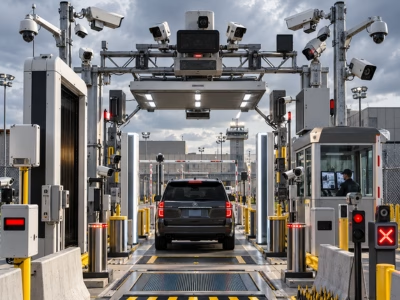
Border agencies, customs officials, correctional facilities, military organizations, and other security agencies face a difficult operational challenge.
Most inspections must be completed quickly while maintaining the efficient movement of legitimate traffic. At the same time, officers must identify the small percentage of vehicles that may be concealing an individual in need of rescue or a criminal attempting to evade detection.
The International Organization for Migration (IOM) has noted that migration routes are frequently exploited by trafficking organizations, making rapid, effective screening capabilities increasingly important at border crossings and transportation hubs.
Finding a concealed person without invasive searches or unnecessary delays requires technologies that can identify what cannot be seen.
A Different Approach to Human Presence Detection
Heartbeat detection technology provides security agencies with a non-invasive method for screening vehicles for concealed occupants.
Rather than relying solely on visual inspection, thermal imaging, or carbon dioxide detection, heartbeat detection is designed to identify the minute physiological vibrations produced by a living human heart; even when an individual is hidden from view.
The technology enables officers to rapidly determine whether additional inspection may be warranted while minimizing disruption to legitimate traffic.
In environments where every inspection decision matters, this additional layer of information can help improve operational efficiency while supporting broader security objectives.
Supporting Security Agencies Worldwide
Heartbeat detection technology has been deployed by global government agencies for decades in support of border security, correctional operations, military force protection, port security, and critical infrastructure protection.
Organizations such as Europol continue to emphasize that organized criminal groups are becoming increasingly sophisticated in their use of concealment methods and cross-border logistics. This evolving threat requires security technologies that are not only accurate, but also adaptable to changing operational environments.
As agencies expand the use of temporary checkpoints, intelligence-led operations, and mobile inspection teams, portability has become as important as detection capability itself.
Designed for Today’s Operational Environment
The latest Geospace Heartbeat Detector® was developed with these evolving operational requirements in mind.
Compared to previous generations, the system is significantly smaller and lighter, making it easier to transport, deploy, and operate at temporary checkpoints, roadside inspections, ports of entry, and other mobile security operations.
The reduced footprint allows officers to establish screening locations more quickly while simplifying transportation and setup for field personnel.
Because trafficking investigations often depend on mobility and rapidly changing intelligence, equipment that can move with officers provides an important operational advantage.
Extending Visibility Beyond the Checkpoint
Modern security operations frequently involve multiple teams working across large geographic areas.
The latest Heartbeat Detector supports this operational model by securely transmitting scan results to the cloud, allowing authorized personnel to review inspection activity remotely.
Whether supporting training, validating field decisions, or providing operational oversight, supervisors can review scan data from virtually anywhere. This additional visibility helps promote consistency across distributed inspection teams while giving command personnel greater awareness of field operations in real time.
The ability to review scan history remotely also supports quality assurance and operational accountability without requiring supervisors to be physically present at every checkpoint.
Technology Supporting a Global Mission
Organizations including INTERPOL, UNODC, and national law enforcement agencies consistently emphasize that combating human trafficking requires international cooperation, intelligence sharing, well-trained personnel, and modern investigative tools.
Technology alone cannot end human trafficking.
However, technologies that help officers detect concealed individuals can provide another critical layer of capability in the effort to identify victims, disrupt trafficking networks, and protect vulnerable lives.
Every successful inspection represents more than a security screening. It may be the moment a hidden victim is found. It may be the disruption of a criminal enterprise. It may be the beginning of someone’s freedom.
As trafficking methods evolve, Geospace remains committed to providing security professionals around the world with advanced heartbeat detection technology designed to support faster deployment, greater operational visibility, and informed decision-making in the field.
Frequently Asked Questions
Can heartbeat detection help combat human trafficking?
Heartbeat detection technology assists law enforcement and security agencies by identifying concealed individuals during vehicle inspections. While it is one component of a broader anti-trafficking strategy, it provides officers with a rapid, non-invasive method for determining whether additional inspection may be necessary.
Where is heartbeat detection technology used?
Heartbeat detection systems are used by border agencies, customs authorities, correctional facilities, military organizations, ports, and other high-security operations around the world to screen vehicles and other enclosed spaces for concealed occupants.
Why is portability important for heartbeat detection systems?
Portable systems allow agencies to deploy heartbeat detection capabilities at temporary checkpoints, intelligence-led operations, roadside inspections, and other mobile security environments where permanent infrastructure is unavailable.
Learn More
Interested in learning more about heartbeat detection technology? Explore additional resources on: