Vehicle inspection operations are changing to reflect the evolving complexity of threats.
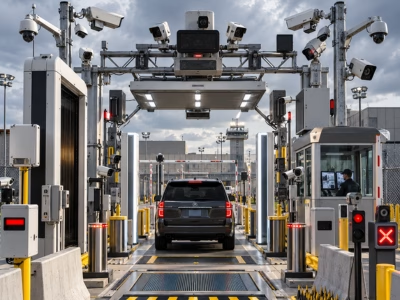
Not long ago, security screening was largely associated with permanent border crossings, correctional facilities, and fixed inspection lanes. Today, security agencies increasingly respond to changing intelligence, emerging threats, special events, and temporary operations that require screening capabilities to be established quickly wherever they are needed.
The U.S. Customs and Border Protection (CBP) describes its border security strategy as a layered approach that includes both permanent and temporary checkpoints, allowing officers to adapt operations as conditions change. As security operations become more dynamic, inspection technology must evolve alongside them.
Portability is no longer simply a convenience. It has become an operational capability.
Security Doesn’t Always Happen at Permanent Checkpoints
Every security mission is different.
Border agencies establish temporary inspection points based on intelligence. Correctional facilities conduct enhanced vehicle screening during special operations. Military organizations establish temporary access control points to protect personnel and critical assets. Law enforcement agencies deploy vehicle inspection capabilities to support major public events, emergency response operations, and critical infrastructure security.
In many of these situations, there is no permanent inspection lane waiting to be used. Equipment must be transported, deployed, operated, and packed away efficiently.
The U.S. Government Accountability Office (GAO) has noted that permanent checkpoints are complemented by tactical, mobile enforcement operations that provide agencies with greater flexibility as operational requirements evolve. The ability to move technology quickly is no longer an advantage—it is part of modern security operations.
Portability Creates Operational Flexibility
Portable inspection technology allows agencies to bring security capabilities to the mission rather than bringing every mission to permanent infrastructure. When intelligence identifies a changing threat, officers need technology that can be transported, deployed, and placed into operation without unnecessary delays.
Rather than limiting inspections to fixed locations, portable systems allow agencies to establish temporary checkpoints, support joint operations, respond to emerging intelligence, or relocate resources as operational priorities shift. This flexibility improves operational readiness by allowing agencies to position equipment where it provides the greatest value.
Technology should adapt to the mission—not the other way around.
Smaller Equipment Improves Efficiency
Portability is about much more than weight. Smaller, lighter equipment is generally easier to transport, faster to deploy, simpler to store, and less physically demanding for personnel working long shifts. Reducing the size and complexity of inspection equipment can decrease setup time, simplify logistics, and allow officers to spend more time conducting inspections instead of managing equipment.
Over hundreds or thousands of vehicle inspections each year, even small improvements in deployment efficiency can produce meaningful operational benefits. For agencies facing staffing shortages and increasing operational demands, efficiency matters.
Portability Supports Operational Readiness
Operational readiness extends beyond detection performance. Equipment must be available when needed, transported without difficulty, deployed rapidly, and operated consistently by field personnel under changing conditions.
Government Accountability Office reviews of Border Patrol checkpoint operations emphasize the importance of effective operational planning, staffing, oversight, and supporting technologies that enable officers to perform their missions efficiently. Portable inspection technology contributes directly to this readiness by allowing agencies to rapidly position screening capabilities wherever operational requirements exist.
When intelligence changes, technology should be able to move with it.
Modern Technology Extends Beyond the Checkpoint
Today’s security operations rarely involve a single inspection team operating from a single location. Supervisors often oversee multiple teams working across large geographic areas. Modern inspection technologies increasingly provide secure cloud connectivity, allowing authorized personnel to review inspection activity remotely.
Remote access to inspection data supports operational oversight, quality assurance, training, and consistent procedures across distributed teams while reducing the need for supervisors to be physically present at every checkpoint. As security operations become increasingly connected, visibility beyond the checkpoint becomes another important element of operational readiness.
Designed for Today’s Missions
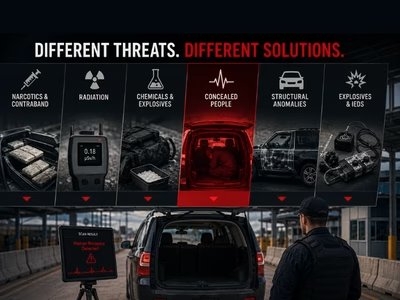
The latest Geospace Heartbeat Detector was engineered around a simple principle: detection capability should never be limited by equipment size or deployment complexity.
Compared with previous generations, the system is dramatically smaller and lighter, making transportation, deployment, and operation significantly easier for field personnel.
Everything required for vehicle screening is organized within a single rugged field case, enabling officers to establish inspection operations quickly at permanent checkpoints, temporary screening locations, correctional facilities, ports, military installations, or other mobile security operations.
The intuitive Heartbeat Detector Scan App simplifies operation while secure cloud connectivity allows authorized personnel to review scan activity remotely, supporting operational oversight, training, verification, and quality assurance across multiple locations.
The result is a heartbeat detection system designed not only to identify concealed individuals, but also to support the mobility and operational flexibility demanded by today’s security professionals.
Mobility Is a Force Multiplier
Modern security organizations are expected to accomplish more with fewer resources while responding to increasingly dynamic operational environments.
Inspection technology should help agencies meet those challenges. Portability enables mobility. Mobility improves operational readiness. Operational readiness allows security professionals to deploy detection capabilities where they are needed most. As vehicle inspection programs continue to evolve, selecting technology designed for mobility, rapid deployment, and operational flexibility will become increasingly important. In today’s security environment, the ability to move the technology can be just as important as the technology itself.