

SADAR® Technology
Persistent Subsurface Intelligence

PRODUCT DETAILS
SADAR® is an event-driven, seismic-acoustic monitoring technology solution that classifies and locates subsurface events of interest, automatically and in near real-time.
THE SADAR® ADVANTAGE
Leveraging compact, phased array processing, SADAR® delivers greater range and accuracy via a reduced seismic data acquisition network. By including spatial processing into the analytic sequence, SADAR® is able to detect, associate, locate, and identify events of interest in the presence of elevated noise and clutter.
Features
- Persistent
- Always on, always listening, always processing
- Real-Time
- Timely information is actionable information resulting in informed decision making
- Highly Sensitive
- Greater Range
- Compact, phased arrays
- Spatial analytics enhance results and disassociate unwanted noise and clutter
- Improved locations with reduced uncertainty
- Reduced Surface Footprint
- Environmental and land owner upside
- Lower risk to lifecycle and maintenance costs
- User Interface Interactive Map Displays
- Array(s) location
- State-of-health status of individual SADAR® arrays
- Detection, classification, and localization alerts
Why Permanent Microseismic Monitoring Matters

Better visibility into what is happening underground
Subsurface operations are expensive and inherently uncertain. Whether stimulating a shale well, managing waterflood pressure, or monitoring CO2 injection, most decisions are made with incomplete real-time information.

Lower operational risk & stronger Regulatory Position
With permanent monitoring, operators reduce risk of shutdowns or operational restrictions, receive a stronger license to operate in sensitive regions with better defensibility with regulators, landowners, and investors.

Better economics than traditional monitoring
Compact permanent arrays can achieve meaningful monitoring coverage with a simpler surface/deployed footprint. This translates to lower lifecycle monitoring costs, less operational disruption, and improves long-term data continuity

Serve two purposes with one installed system
Support both passive monitoring (listening for natural/induced events) and active imaging (creating subsurface images using vibration sources). This “dual-use” capability increases return on infrastructure investment.

More data-driven capital allocation
Simply put, better data can mean fewer poorly placed wells and better returns on completion spend.

Strategic Advantage for Energy Transition Projects
SADAR provides a differentiator when securing regulatory approvals, JV partnerships, investor confidence or carbon credit validation.
Frequently Asked Questions on SADAR Technology
What is a SADAR array?
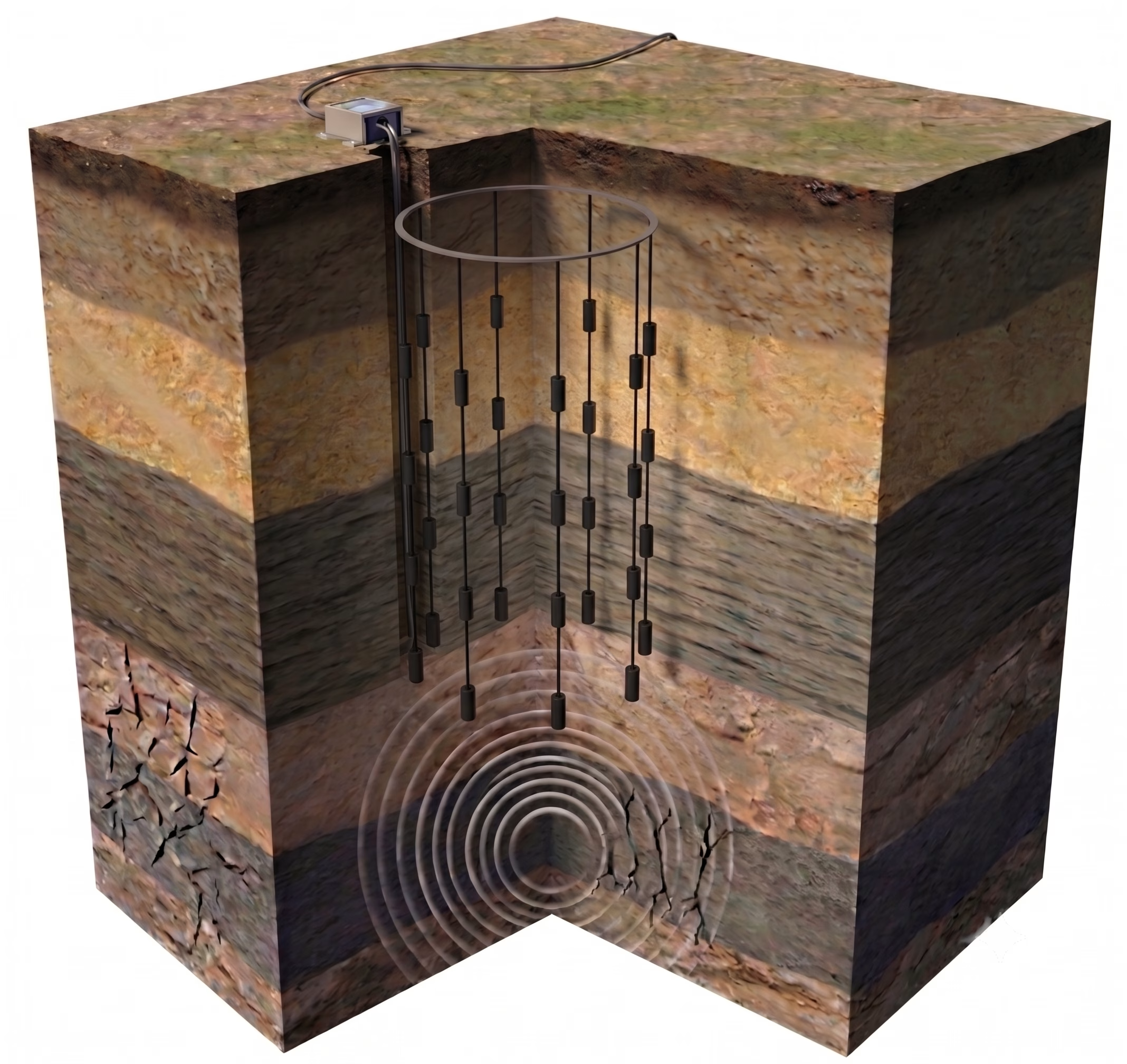
A SADAR array is a compact volumetric phased array of seismic sensors designed for continuous subsurface monitoring. Unlike traditional monitoring systems that rely on surface sensors or downhole sensor strings, SADAR arrays are installed in shallow boreholes below the weathering layer and use proprietary SADAR technology beamforming techniques to improve signal quality and event detection.
At Carbon Management Canada’s Field Research Station in Alberta, Canada, four permanently installed SADAR arrays were used to continuously monitor microseismic activity while also supporting active-source seismic imaging. The system operated at greater than 98.7% availability over a 42-month period and demonstrated the ability to monitor a large area using a relatively small surface footprint.
Why are arrays using SADAR technology installed below the weathering layer?
Arrays using SADAR technology identify burial below the weathering layer as a key design feature. Installing sensors in shallow boreholes helps reduce the impact of industrial and environmental noise that can affect surface sensors.
Field comparisons between buried SADAR sensors and surface arrays showed lower noise levels and improved signal quality for the buried system. When combined with beamforming, the approach further improves the ability to detect and characterize low-magnitude seismic events.
How reliable is the SADAR technology?
The field deployment described in the papers consisted of four permanent SADAR arrays installed in November 2021 at Carbon Management Canada’s Field Research Station in Alberta.
The installation was completed in approximately one week and achieved operational availability of 98.7% or greater over a monitoring period of approximately 42 months. The studies also evaluated the effect of sensor loss and found that key monitoring capabilities remained largely intact even after the loss of approximately 27% of the sensors in an array.
GEORES s8 (SERVER)
|
19in Rack-Mount Chassis
|
4U
|
|
SADAR-E Array Line Support per Chassis
|
8
|
|
SADAR-E Arrays per Line
|
7
|
|
Operating Temperature
|
-20°C to 60°C
|
|
Input Voltage Power
|
100-260 VAC, 10W
|
|
Array Power Supplied via 450-05290-xx
|
Passthrough
|
|
Dimensions
|
19 in (W) x 13.5 (D) x 7 in (H)48.26 cm (W) x 34.29 cm (D) x 17.78 cm (H)
|
|
Weight
|
11 lbs/5 kg
|
Electrical Specifications
|
All parameters are specified at 25°C in the vertical position unless
otherwise stated. |
||
|
GS-ONE
|
GS-ONE LF
|
|
|
Response Frequency
|
10 Hz, ± 0.35 Hz
|
5 Hz, ± 0.5 Hz
|
|
Spurious frequency
|
240 Hz Typical
|
160 Hz Typical
|
|
Distortion at Vertical*
|
0.05% Typical
|
<0.10% Typical
|
|
Sensitivity with 20 kΩ load
|
2.00 V/in/s (78.7 V/m/s) Typical
|
2.27 V/in/s (89.4 V/m/s) Typical
|
|
Damping with 20 kΩ load
|
0.70 Typical
|
0.670 Typical
|
|
DC resistance
|
1800 Ω, ± 5%
|
2450 Ω, ± 5%
|
|
*Distortion Measured @ 12 Hz with 0.7 in/s Pk-Pk Velocity
|
|
Digitization
|
24-Bit Delta-Sigma
|
|
Sample Rate
|
0.5, 1, 2, 4 ms
|
|
Preamplifier Gains
|
0, 6, 12, 18, 24, 30, 36 dB
|
|
Maximum Input Signal for Sensor
|
26 mm/sec
|
|
Equivalent Input Noise
|
@ 2 ms sample rate 1.77 μmm/sec rms
|
|
Gain Accuracy
|
Better than 1%
|
|
Anti-alias Filter
|
83% Nyquist
|
|
Instantaneous Dynamic Range
|
124 dB @ 2 ms sample interval
|
|
Crossfeed Isolation
|
>90 dB
|
|
THD
|
<0.2%
|

