Decades of Research, Testing, and Security Applications
A person concealed inside a vehicle may be out of sight, but their heartbeat produces a small physical signal.
Every beat creates mechanical forces that travel through the body and into surfaces it contacts. Sensitive sensors can detect the resulting vibrations in a vehicle’s structure. Specialized software then analyzes those signals for evidence of human presence.
This principle is the foundation of Heartbeat Detector®, a heartbeat detection technology, and its history reaches back decades.
From National Laboratory Research to Vehicle Security
During the 1990s, researchers at Oak Ridge National Laboratory (ORNL) developed an Enclosed Space Detection System, a heartbeat detector technology to address a persistent security challenge: detecting people hidden inside vehicles crossing secure boundaries.
The need was clear. Thorough visual searches could consume substantial time and personnel, particularly when inspecting enclosed cargo areas. Researchers explored whether the human heartbeat offered another way to identify concealed occupants.
Their work focused on the ballistocardiogram: the small mechanical response generated as the heart pumps blood. When those forces transfer into a vehicle, sensors can collect vibration signals from outside the enclosed space.
The challenge is separating those faint signals from background vibration. The early heartbeat detector technology used signal processing to identify patterns associated with a heartbeat.
A Documented History of Testing
A paper presented at an International Atomic Energy Agency conference in 1997 and published in 1998 described the heartbeat detector technology development, operation, and early use in state prisons. It also documented independent testing at Thunder Mountain Evaluation Center, a specialized U.S. government testing facility at Fort Huachuca, Arizona.
A separate 1997 ORNL publication discussed the system in comparison with conventional inspection methods and referenced the same independent evaluation.
Together, these publications establish that heartbeat-based vehicle screening had progressed beyond a laboratory concept into testing and operational applications by the 1990s.
The papers describe earlier equipment and software configurations. Their numerical results belong to those historical systems and should be understood in that context. Their lasting value is the record they provide of the technology’s scientific foundation, evaluation, and practical application.
What the Early Research Still Teaches Us
The historical research also explains why a careful vehicle security inspection process matters when seeking to avoid the entry or exit of unauthorized humans.
Vehicle characteristics influence how vibrations travel through a structure. Wind and other sources of vibration can affect the signals collected by the sensors. Sensor placement, operating conditions, and appropriate analysis all contribute to the screening process.
These findings help explain the engineering behind heartbeat detection. Collecting a vibration is only the beginning; interpreting it requires an understanding of both the heartbeat signal and the surrounding environment.
An Established Principle in a Modern System
Today’s Heartbeat Detector® carries that research heritage into a portable vehicle-screening system from Geospace Technologies.
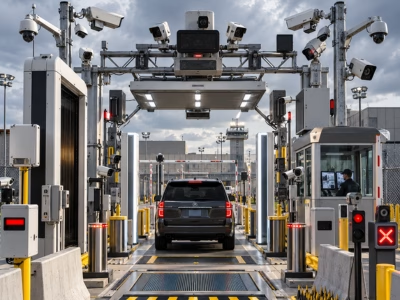
Sensors placed on a vehicle collect vibrations for analysis, helping security personnel identify concealed human presence without relying solely on what they can see. The technology supports screening applications at correctional facilities, border crossings, and other secure locations.
Its role fits naturally within a layered inspection strategy. Visual searches and other inspection tools provide information about a vehicle and its contents. Heartbeat detection adds information focused on the presence of a concealed person.
See the Technology in Action
For security teams evaluating human-presence detection, the research history provides a meaningful starting point: an established physical principle, documented independent testing of early systems, and decades of security applications.
A demonstration connects that history to your inspection needs today.
Schedule a Heartbeat Detector® demonstration to explore how the system can support your vehicle-screening operation.
Article Author:
Reference Resources:
G. M. Fuller, Electronic Methods to Detect Persons Hidden Within Cargo Containers, IAEA conference proceedings, 1998, pp. 357–363.
S. W. Kercel, V. M. Baylor, and L. E. Labaj, Comparison of Enclosed Space Detection System with Conventional Methods, 1997.