Balancing seismic performance, operational efficiency, and survey economics
Ocean-bottom node (OBN) technology continues to play an important role in modern marine seismic acquisition, providing the multicomponent data needed for increasingly complex subsurface imaging applications.
Selecting the right equipment involves balancing survey objectives with efficient deployment, reliable recording, and predictable offshore operations.
While survey geometry and subsurface imaging requirements drive acquisition design, equipment characteristics influence how efficiently a survey can be executed. Sensor performance, recording endurance, deployment methods, equipment turnaround, and long-term reliability all contribute to the technical and economic evaluation.
Understanding how these factors work together provides a more complete picture of OBN performance and operational value.
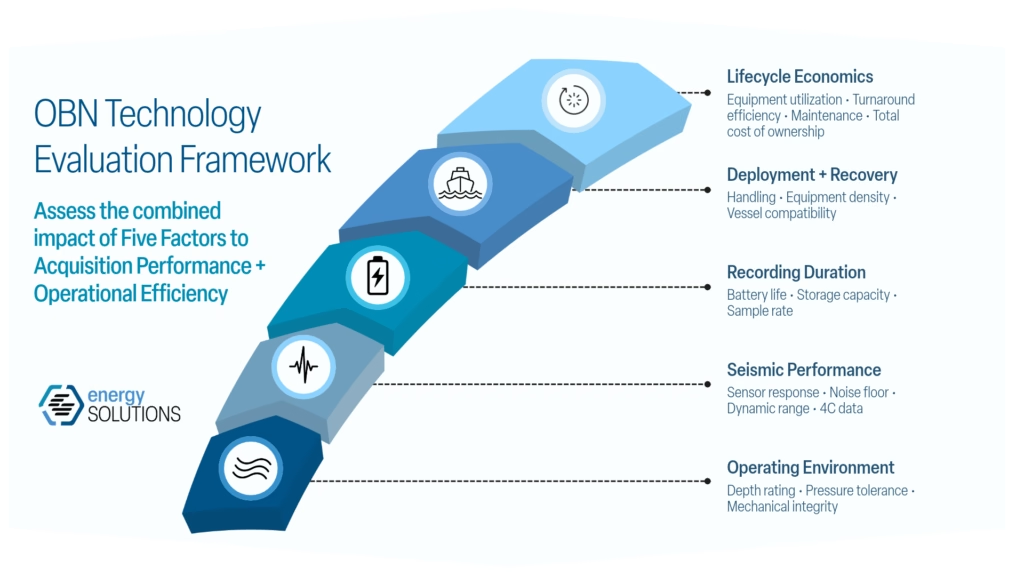
Five Factors That Shape OBN Technology Evaluation
Evaluating ocean-bottom node technology involves five interconnected considerations:
- Operating Environment: Water-depth rating, pressure tolerance, and mechanical integrity.
- Seismic Performance: Sensor response, noise floor, dynamic range, and four-component recording.
- Recording Endurance: Battery capacity, onboard storage, sample rate, and acquisition duration.
- Deployment and Recovery: Node dimensions, equipment handling, vessel compatibility, and turnaround requirements.
- Lifecycle Economics: Equipment utilization, maintenance, operational efficiency, and total cost of ownership.
These factors are best evaluated collectively. A specification that appears advantageous in isolation may offer limited value if other equipment characteristics constrain the acquisition program.
For example, extended battery life provides practical value only when memory capacity, recording configuration, and system reliability support the planned deployment period. Similarly, a compact node design offers operational advantages when storage density, charging infrastructure, and handling processes complement the overall acquisition workflow.
Operating Environment and Mechanical Design
Water-depth ratings and mechanical specifications establish the operating boundaries of an ocean-bottom node. Pressure tolerance, housing construction, and environmental protection influence equipment reliability throughout deployment and recovery.
Beyond depth capability, node dimensions, weight, and mechanical configuration affect vessel operations and compatibility with deployment systems.
Shallow-water operations may place greater emphasis on compact equipment, handling efficiency, and rapid turnaround. Deepwater acquisition often introduces additional logistical demands involving specialized deployment systems, recovery operations, and extended offshore schedules.
Geospace offers two ocean-bottom node systems designed for different operating environments:
- Mariner supports acquisition at depths up to 750 meters, with continuous recording capability of up to 70 days.
- Mariner Deep supports deepwater acquisition at depths up to 3,048 meters, with continuous recording capability of up to 200 days.
Mechanical design and operating specifications provide an important foundation for evaluating equipment reliability and compatibility with established acquisition practices.
Seismic Performance and Data Quality
Seismic data quality begins with sensor design and the performance of the acquisition electronics.
Four-component (4C) ocean-bottom recording combines three-component particle-motion measurements with pressure measurements from a hydrophone. These complementary measurements support multicomponent seismic processing and subsurface imaging.
Performance considerations include sensor sensitivity, frequency response, instrument noise, dynamic range, digitization, and orientation measurements.
Specifications should be considered in relation to the acquisition objectives and expected recording conditions. Low instrument noise, high dynamic range, and accurate timing contribute to data fidelity, while sensor orientation information supports subsequent processing.
Geospace Mariner and Mariner Deep incorporate GS-ONE OMNI geophones and hydrophones for autonomous four-component recording. Both systems include internal heading sensors and built-in testing capabilities to support equipment verification.
The combined performance of the sensors, recording electronics, and system configuration ultimately determines the quality and consistency of acquired data.
Recording Duration and Acquisition Flexibility
Battery life and onboard recording capacity influence acquisition scheduling, equipment utilization, and servicing requirements.
Longer recording duration provides greater flexibility for projects involving extended acquisition windows, challenging weather conditions, or complex deployment and recovery logistics.
However, maximum battery life alone does not establish the practical recording capability of an OBN system.
Sample interval, channel count, memory capacity, battery performance, and power consumption collectively determine whether a node can support the intended acquisition period.
The relationship between these specifications becomes particularly important when comparing systems with different recording architectures.
Mariner provides up to 70 days of continuous autonomous recording, while Mariner Deep extends recording capability to 200 days.
Extended recording duration can reduce battery-related servicing requirements and provide greater scheduling flexibility. The operational value depends on the complete recording configuration and the demands of the acquisition program.
Deployment, Recovery, and Equipment Handling
Deployment and recovery methods influence offshore efficiency, equipment requirements, and vessel utilization.
Depending on the survey, ocean-bottom nodes may be deployed through node-on-a-rope systems, remotely operated vehicle (ROV) placement, or other specialized methods. Each approach introduces different considerations for positioning, handling, recovery, and vessel operations.
Node dimensions, weight, mechanical configuration, and compatibility with handling systems influence the efficiency of these activities.
Compact equipment can improve onboard storage density and simplify handling, particularly when acquisition programs involve large node inventories.
Mariner’s slim-profile design increases node capacity within charging and download containers, helping contractors make more efficient use of available vessel space.
Operational efficiency also depends on the relationship between node design and the broader deployment system. Equipment handling, storage arrangements, charging infrastructure, and data transfer processes collectively influence offshore productivity.
Charging, Data Download, and Equipment Turnaround
OBN productivity extends beyond the time that nodes spend recording on the seafloor.
Following recovery, equipment preparation may involve data download, battery charging, testing, inspection, and handling before subsequent deployment.
The efficiency of these processes affects equipment availability and overall acquisition productivity.
Systems that simplify charging and data transfer can reduce repetitive handling requirements and improve equipment turnaround, particularly for contractors managing large node inventories.
Mariner incorporates wireless, connector-free charging and data download technology. Eliminating external connectors from these operations reduces the number of physical connections required during equipment preparation.
Equipment turnaround becomes an increasingly important consideration as survey scale, channel count, and deployment frequency increase.
Evaluating Ocean-Bottom Node Survey Economics
The acquisition price of an OBN system represents only one component of its total economic value.
Survey economics also reflect equipment utilization, vessel requirements, deployment and recovery efficiency, maintenance, equipment turnaround, and recording reliability.
Several factors contribute to the evaluation:
Equipment density and logistics: Compact node designs can improve storage efficiency and reduce onboard space requirements.
Recording endurance: Extended autonomous operation provides scheduling flexibility and may reduce servicing interruptions.
Equipment turnaround: Efficient charging, testing, and data transfer support equipment availability between deployments.
Reliability and data confidence: Consistent recording performance helps protect acquisition investments and reduces the risk of equipment-related data loss.
Lifecycle costs: Maintenance requirements, equipment longevity, inventory utilization, and handling efficiency influence total cost of ownership.
These considerations become particularly significant when evaluating large OBN inventories deployed across multiple projects.
Comparing equipment solely on initial purchase or rental cost can overlook operational differences that influence project economics. A broader evaluation considers how equipment design and performance contribute to efficient acquisition throughout the equipment’s service life.
Matching OBN Technology to Acquisition Requirements
Ocean-bottom node performance is best evaluated through the combined contribution of seismic capability, mechanical design, recording endurance, and operational efficiency.
Equipment specifications provide essential technical benchmarks, but their practical value depends on how effectively they support the complete acquisition workflow.
Geospace designs and manufactures ocean-bottom seismic acquisition technology with an emphasis on high-fidelity sensing, dependable recording, and operational efficiency.
Its Mariner and Mariner Deep systems provide four-component seismic recording capabilities for different marine operating environments, supported by Geospace’s experience in seismic sensor and acquisition technology.
Explore Geospace Ocean-Bottom Node Solutions
Mariner: Shallow-Water Ocean-Bottom Node
Compact four-component seismic acquisition technology designed for shallow-water surveys, efficient equipment handling, and streamlined charging and data transfer.
Mariner Deep: Deepwater Ocean-Bottom Node
Extended-duration four-component seismic acquisition technology designed for deepwater operations, with continuous recording capability of up to 200 days.
Discuss Your Acquisition Requirements
Contact Geospace to discuss ocean-bottom node specifications, equipment configurations, and availability for your next marine seismic survey.