Five Questions Every Agency Should Ask
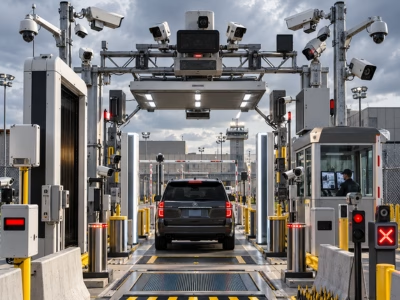
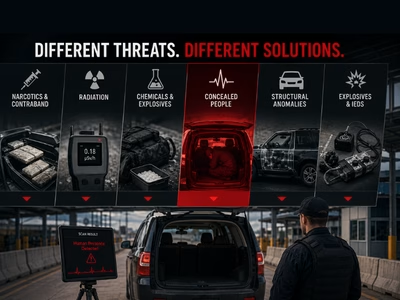
Every correctional facility has security procedures designed to reduce risk. Cameras monitor activity, officers inspect vehicles, and access controls help regulate who enters and leaves the facility. Yet one challenge remains uniquely difficult: detecting a concealed person hidden inside a vehicle.
Human presence detection systems, heartbeat detectors, and enclosed space detection systems have become an increasingly important layer of security for correctional facilities, border agencies, and other high-security environments. As more technologies enter the market, however, choosing the right system has become more complicated than simply comparing product specifications.
Agencies now have more options than ever before. Manufacturers offer systems based on different sensing technologies, software approaches, deployment models, and ownership structures. While this increased competition gives buyers more choice, it also makes objective evaluation more important.
Many products appear similar on paper. Most promise fast detection, high accuracy, and easy operation. The real differences often emerge only after asking the right questions.
Here are five questions every agency should consider before selecting a human presence detection system.
1. What Is the System Actually Detecting?
Not all human presence detection systems work the same way.
Some technologies monitor minute vibrations associated with a human heartbeat. Others detect subtle body movement or combine multiple sensing methods. While each approach is designed to identify concealed occupants, understanding what physical signal is being measured provides important context for evaluating performance claims.
Rather than focusing only on marketing language, ask vendors to explain the underlying sensing technology and how it detects human presence. A clear explanation builds confidence that the technology is appropriate for your operational environment.
2. How Will It Perform in Real Operating Conditions?
Security checkpoints rarely operate under laboratory conditions.
Vehicle engines are running. Weather changes. Heavy trucks create vibration. Officers work under time pressure, often screening dozens of vehicles during a shift.
When evaluating a system, consider how it performs in the environment where it will actually be used, not just during controlled demonstrations. Ask whether performance has been validated under typical operating conditions and how environmental factors are managed.
It’s also worth asking how long the heartbeat detection technology has been operating in the field. Systems with many years of operational deployment have often benefited from thousands of inspections across diverse environments, allowing developers to continuously refine detection algorithms, improve signal processing, and better understand real-world operating conditions. That operational experience can be just as valuable as laboratory testing.
Real-world reliability is often more valuable than an impressive specification sheet.
3. Will It Fit Into Daily Operations?
Even the most advanced technology delivers little value if it disrupts the checkpoint.
A screening system should complement existing security procedures, not complicate them. Consider how long a typical inspection takes, how much operator training is required, and whether results are presented in a clear, intuitive manner.
Technology that is simple to deploy and easy to operate is more likely to be used consistently, helping agencies maintain both security and throughput.
4. What Happens After the Purchase?
Selecting a human presence detection system is a long-term investment, not a one-time purchase.
Maintenance requirements, software updates, technical support, training, equipment lifecycle, and warranty coverage all contribute to the total cost of ownership. Procurement teams should also consider how the vendor supports the system after deployment. For example, some manufacturers now offer subscription-based ownership models that include hardware replacement, software updates, and technical support as part of the service. These programs can simplify budgeting, eliminate warranty administration, and help agencies maintain continuous operational readiness without managing equipment repairs or replacement logistics.
Looking beyond the initial purchase price often provides a more complete picture of long-term value.
5. Is the Vendor Helping You Make an Informed Decision?
Perhaps the most overlooked question has nothing to do with the technology itself.
A reputable vendor should be willing to explain how the system works, discuss its operational considerations, and provide meaningful documentation or demonstrations. The goal should be to help agencies make informed decisions—not simply promote product features.
The more transparent the evaluation process, the greater confidence decision-makers can have in the final selection.
Conclusion
Human presence detection technology has become an important component of modern correctional and security operations. While today’s systems continue to evolve, the principles of good procurement remain unchanged: understand the mission, ask thoughtful questions, and evaluate technologies based on operational performance rather than marketing claims alone.
Whether referred to as a heartbeat detector, a human presence detection system, or an enclosed space detection system, these technologies all share the same objective: detecting people hidden inside vehicles before they can enter or leave a secure facility.
Agencies that begin with the right questions are far more likely to select a solution that supports their mission for years to come.
Evaluation Worksheet
Selecting a human presence detection system involves more than comparing product brochures. We’ve developed a Heartbeat Detection System Evaluation Worksheet to help agencies compare competing technologies using consistent, objective criteria.
Download the free checklist to guide your next technology evaluation.