Does Every Security Upgrade Need to Be a Capital Project?
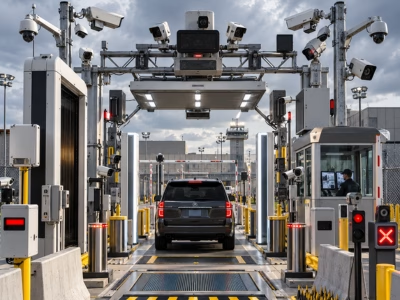
Improving vehicle security can quickly become a major undertaking. Large-scale inspection systems may require significant equipment investment, construction, power, site modifications, technology integration, training and ongoing maintenance. For major ports of entry and high-volume inspection environments, those investments can be entirely appropriate.
Not every security problem, however, requires the same level of infrastructure.
For government agencies evaluating vehicle inspection technology, cost should include more than the purchase price of the equipment. Infrastructure requirements, implementation time, procurement complexity, maintenance and the ability to deploy the technology where it is needed all contribute to the real cost of adding a new security capability.
The better question may not be, “How much does a vehicle inspection system cost?” It may be, “How much infrastructure and investment does our particular security mission require?”
Vehicle Inspection System Cost Goes Beyond the Equipment
Large-scale Non-Intrusive Inspection (NII) systems demonstrate how quickly an inspection technology can become an infrastructure project.
U.S. Customs and Border Protection (CBP) has invested extensively in large-scale NII systems that allow entire vehicles to be scanned at land ports of entry. These systems provide important inspection capabilities in environments where large numbers of vehicles must be screened for multiple potential threats.
The U.S. Government Accountability Office (GAO), however, has documented the infrastructure required to deploy this technology. According to a 2026 GAO review, CBP originally estimated installation costs for its Multi-Energy Portal systems at approximately $1.3 million per installation in fiscal year 2020. By fiscal year 2023, vendor estimates averaged approximately $4.1 million per installation. In October 2024, CBP estimated that completing each remaining installation could cost between $4.2 million and $9.7 million.
Those figures relate to major federal border infrastructure and should not be interpreted as representative of every X-ray or NII system. They illustrate a larger point: the cost of inspection technology can extend well beyond the equipment itself.
Civil construction, utilities, site preparation and integration can turn a technology purchase into a significant capital project.
The Right Investment Depends on the Mission
Large-scale infrastructure makes sense when the mission requires large-scale capability.
A busy international port processing thousands of commercial vehicles may need broad inspection capabilities, permanent infrastructure and systems capable of identifying many different types of anomalies. The operational value can justify a substantial investment.
A correctional facility may have a very different requirement. A military installation, regional border operation or secure government facility may also face a narrower threat profile or inspect significantly fewer vehicles.
In these environments, replicating the infrastructure of a major port of entry may provide capabilities the facility does not need while adding cost and complexity it does not require.
Security investments should therefore be proportional to the mission. The objective is not to spend as little as possible. The objective is to acquire enough capability to reliably address the identified security requirement without unnecessarily expanding the scope of the project.
Procurement Complexity Is Part of Deployment Time
Cost also affects how quickly technology can reach the people who need it.
As acquisition values increase, government purchases can become subject to additional procurement procedures, competition requirements, contracting involvement and approval processes. Those controls serve important purposes, including competition, accountability and responsible stewardship of public funds.
Federal acquisition policy also recognizes that smaller acquisitions should not necessarily follow the same process as major procurements. The Federal Acquisition Regulation directs agencies to use simplified acquisition procedures to the maximum extent practicable for eligible purchases below the Simplified Acquisition Threshold. Effective October 1, 2025, the general federal Simplified Acquisition Threshold increased from $250,000 to $350,000.
Individual agencies, state and local governments, correctional systems and international governments operate under their own purchasing authorities and approval structures, so no single threshold applies universally.
The underlying principle is useful regardless of jurisdiction: the scale of the procurement process should be appropriate to the scale of the requirement.
For a security manager, this can have a practical operational consequence. A solution that requires a major capital appropriation may compete with other large infrastructure priorities and follow a lengthy budget cycle. A right-sized solution may be acquired and deployed through a more appropriate purchasing path, subject to the organization’s applicable procurement rules.
Security as a Service Changes the Cost Equation
The way organizations acquire technology is changing as well.
Software-as-a-service models have made recurring operating expenses familiar across government and commercial organizations. Similar approaches can be applied to specialized security technology by combining equipment, software, support and service into a predictable recurring cost rather than requiring a large upfront equipment purchase.
For certain applications, this approach can reduce the initial financial barrier to deploying new security capabilities. It can also change the way organizations think about lifecycle cost.
Instead of purchasing equipment and separately planning for software, support, repairs and eventual replacement, an integrated service model can provide greater cost predictability while helping ensure the technology remains operational.
The appropriate acquisition model will depend on an organization’s procurement rules, budget structure and long-term requirements. Capital ownership remains appropriate for many security systems. A service-based model provides another option when flexibility, predictable cost and continued support are priorities.
Human-Presence Detection Without Major Infrastructure
Concealed-person detection provides a useful example of how a specialized security requirement can be addressed without building a large inspection installation.
The Geospace Heartbeat Detector is purpose-built to help determine whether a living person may be concealed inside a stationary vehicle. Sensors placed on the vehicle detect minute mechanical vibrations, while signal-processing technology analyzes those signals for indications consistent with human presence.
The system does not require the permanent infrastructure associated with large-scale vehicle imaging installations. Its portable design allows the equipment to be transported and deployed where human-presence screening is required.
Geospace also offers the Heartbeat Detector through a subscription model that combines the hardware, software and support into a predictable recurring cost. This approach reduces the upfront investment required to establish a concealed-person detection capability while helping agencies plan for the ongoing cost of maintaining that capability.
For facilities whose primary concern is concealed people rather than broad inspection of vehicle contents, the difference in deployment model can be significant.
Think in Terms of Capability, Not Equipment
Security procurement discussions frequently begin with equipment: a scanner, camera, sensor or detection system.
A more useful approach is to define the capability the organization needs.
If the requirement is “improve vehicle security,” the potential scope is enormous. If the requirement is “determine whether a person may be concealed inside vehicles entering or leaving this facility,” the problem becomes much more specific.
A specific requirement makes it easier to evaluate the appropriate technology, infrastructure and acquisition model. It also helps organizations distinguish between capabilities they need today and capabilities that may be useful but are not essential to the mission.
This approach does not argue against sophisticated security infrastructure. It helps ensure sophisticated infrastructure is deployed where its capabilities justify the investment.
Consider the Total Cost of Deployment
Government buyers evaluating vehicle inspection system cost should consider several factors beyond the equipment price. Site preparation and construction, power and communications infrastructure, installation, software, training, maintenance, staffing requirements, service contracts and eventual technology replacement can all affect total lifecycle cost.
Portability can also have economic value. Equipment that can be moved between locations or deployed temporarily may allow an organization to extend a security capability across multiple operational environments without constructing permanent infrastructure at every location.
The lowest purchase price will not always represent the lowest total cost, just as the most expensive technology will not necessarily provide the best operational fit.
A useful comparison asks what it will cost to acquire, deploy, operate and sustain the required capability.
Right-Sized Security Can Accelerate Readiness
Security organizations face a difficult balance. They must address real threats while competing for limited personnel, funding and management attention.
Every security improvement cannot become a multimillion-dollar infrastructure project.
Fortunately, every improvement does not need to.
Advances in sensors, software, signal processing, connectivity and portable technology are creating opportunities to deploy specialized security capabilities with less permanent infrastructure. New acquisition models can further reduce the upfront investment required to put those capabilities into operation.
Large-scale inspection infrastructure will continue to play an essential role in environments where the mission demands it. Smaller, specialized systems can address other requirements more efficiently.
The goal should not be the largest security system an organization can acquire.
The goal should be the right capability, at the right scale, with a cost and deployment model appropriate to the mission.
Author
Frequently Asked Questions
How much does a vehicle inspection system cost?
Vehicle inspection system costs vary widely depending on the technology and installation requirements. Portable specialized systems can require relatively little infrastructure, while large-scale vehicle imaging systems may involve substantial equipment, construction and installation costs. Government buyers should evaluate total deployment and lifecycle cost rather than equipment price alone.
What costs should be considered when buying vehicle inspection technology?
Organizations should consider equipment, construction or site preparation, installation, power and communications requirements, software, training, maintenance, staffing, support and eventual replacement. Portability and the ability to use equipment across multiple locations may also affect total cost.
Does vehicle inspection equipment require permanent infrastructure?
Not always. Large-scale imaging systems may require substantial permanent infrastructure, while other vehicle inspection technologies are portable and can operate without major site construction. Infrastructure requirements depend on the inspection technology and mission.
Can security equipment be purchased as a subscription?
Some security technologies are available through subscription or service-based acquisition models that combine equipment, software and support into a recurring cost. The availability and appropriateness of these models depend on the technology and the purchasing organization’s procurement requirements.
What is the federal Simplified Acquisition Threshold?
As of October 1, 2025, the general Simplified Acquisition Threshold under the Federal Acquisition Regulation is $350,000, although different thresholds and additional rules can apply in certain circumstances. Agencies must follow applicable acquisition regulations and cannot divide larger requirements into smaller purchases simply to remain below procurement thresholds.
References
U.S. Government Accountability Office (GAO)
Border Security: Improvements Needed to Increase Vehicle Scanning at Land Ports of Entry (2026)
GAO documents the cost and infrastructure challenges associated with CBP’s deployment of large-scale Non-Intrusive Inspection systems, including significant increases in construction and installation costs.
Federal Acquisition Regulatory Council / Acquisition.gov
Threshold Changes – October 1, 2025
The federal acquisition resource documents the increase in the general Simplified Acquisition Threshold from $250,000 to $350,000 and the Micro-Purchase Threshold from $10,000 to $15,000.
Federal Acquisition Regulation (FAR), Part 13
Simplified Acquisition Procedures
The FAR directs federal agencies to use simplified acquisition procedures to the maximum extent practicable for eligible acquisitions within applicable thresholds while maintaining competition and procurement safeguards.