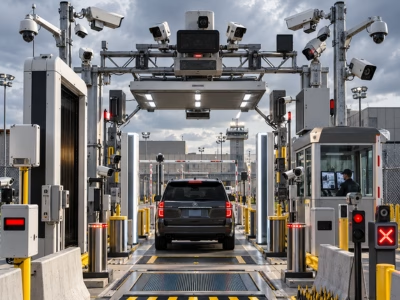
Vehicle inspections are one of the most critical security functions performed at a correctional facility. Every employee, contractor, vendor, service provider, and delivery vehicle entering or leaving secure grounds represents an opportunity to verify authorization, prevent contraband, and detect unauthorized occupants before they reach the institution.
At the same time, correctional facilities cannot afford for vehicle inspections to become operational bottlenecks.
Deliveries must arrive on schedule. Staff members must report for duty. Contractors must complete essential work. Emergency vehicles may require immediate access. Security and operational efficiency are not competing priorities. Both are essential to keeping a correctional facility functioning safely.
The challenge facing correctional leaders is straightforward:
How do you strengthen vehicle inspections without slowing facility operations?
Effective Security Supports Operations
There is a common misconception that stronger security inevitably means slower operations.
In practice, the opposite is often true.
Well-designed inspection procedures improve consistency, reduce unnecessary delays, and allow officers to spend more time evaluating genuine security concerns instead of resolving administrative issues or performing repetitive manual inspections.
Research supported by the National Institute of Justice (NIJ) consistently emphasizes that correctional security is most effective when agencies employ layered security practices supported by trained personnel, established procedures, and appropriate technologies rather than relying on any single security measure.
Vehicle inspections are one important layer within that larger security strategy.
Every Vehicle Presents a Different Challenge
Unlike many security checkpoints, correctional vehicle inspections rarely follow a predictable pattern.
Throughout the day, officers may inspect:
- Employee vehicles
- Food deliveries
- Medical suppliers
- Utility contractors
- Construction vehicles
- Waste removal trucks
- Law enforcement vehicles
- Maintenance crews
Each vehicle serves a legitimate operational purpose while presenting unique inspection considerations.
Treating every vehicle as though it presents the same level of risk is rarely the most effective use of limited personnel. Instead, facilities benefit from standardized procedures that allow officers to conduct consistent inspections while adapting to different vehicle types and operational circumstances.
Throughput Begins with Good Process
Maintaining efficient vehicle movement begins long before a vehicle reaches the inspection point.
Facilities can improve throughput by reducing avoidable delays through measures such as:
- Scheduled delivery windows
- Clearly communicated entry procedures
- Pre-authorized contractor access
- Complete documentation before arrival
- Defined inspection responsibilities
When administrative processes are organized, officers spend less time resolving paperwork issues and more time performing meaningful security inspections.
Consistency improves both security and efficiency.
Technology Should Help Officers Keep Vehicles Moving
Technology should never complicate the inspection process.
Its purpose is to help officers make informed decisions more quickly while preserving established security procedures.
This is where modern screening technologies can play an important role.
For example, heartbeat detection provides a fast, non-invasive method of screening vehicles for concealed occupants without requiring officers to immediately escalate to more time-consuming manual inspection methods. Rather than replacing established inspection procedures, it adds another layer of information that helps officers determine whether additional investigation is warranted.
That distinction is important.
The goal is not to inspect every vehicle more extensively.
The goal is to identify the vehicles that require additional attention while allowing legitimate traffic to continue moving safely and efficiently.
When thoughtfully integrated into checkpoint operations, technologies like heartbeat detection can help facilities improve throughput, reduce unnecessary delays, and make better use of limited personnel without compromising security.
Better Throughput Is Better Security
Correctional administrators are often asked to accomplish two objectives that appear to conflict.
Increase security.
Maintain operational efficiency.
In reality, these goals support one another.
Predictable inspection procedures reduce uncertainty.
Consistent screening reduces unnecessary variation.
Efficient checkpoints allow officers to focus their attention where it is most needed.
Strong vehicle inspection programs are not measured solely by how many vehicles are processed each hour. They are measured by how consistently they identify potential threats while allowing legitimate facility operations to continue without unnecessary disruption.
Making Inspections an Opportunity
Vehicle inspections remain one of the first opportunities to prevent unauthorized persons and prohibited items from entering or leaving a correctional facility.
As staffing shortages and operational demands continue to challenge correctional agencies, improving both security and throughput has become increasingly important.
Facilities that combine trained personnel, standardized inspection procedures, layered security practices, and technologies that support fast, non-invasive screening are better positioned to strengthen security while maintaining the operational pace required to keep the institution running effectively.
Vehicle inspections should not become the bottleneck.
Author
They should become one of the facility’s greatest operational strengths.
Learn More
- National Institute of Justice – Experts Identify Priority Needs for Addressing Correctional Agency Security Threats
https://nij.ojp.gov/topics/articles/experts-identify-priority-needs-addressing-correctional-agency-security-threats - National Institute of Justice – Contraband and Interdiction Strategies in Correctional Facilities
https://nij.ojp.gov/library/publications/contraband-and-interdiction-strategies-correctional-facilities - National Institute of Justice – Correctional Facilities Research
https://nij.ojp.gov/topics/corrections/correctional-facilities