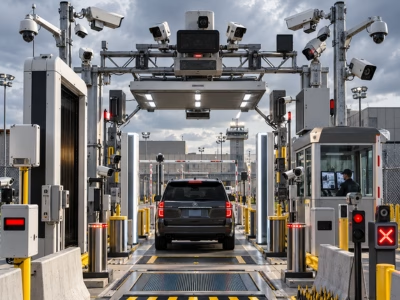
How 60-Second Heartbeat Scans Change the Game
Every correctional facility lives with a simple truth: the perimeter is only as strong as its gates—especially the high-throughput gates where box trucks, garbage trucks, laundry vehicles, food service lorries, and contractor rigs roll in and out all day. These vehicles are big, irregularly shaped, and often carry dense loads that defeat line-of-sight checks. Add shift changes, time pressure, and uneven procedures, and you’ve got the most tempting place to attempt an escape—or an intrusion.
Vehicle concealment is a known tactic
While comprehensive national statistics that break down escapes by method are limited, documented cases repeatedly show inmates exploiting vehicles or loading workflows to slip out:
- Laundry/Service trucks: In Nebraska, two inmates escaped Lincoln Correctional Center by hiding in a laundry cart that was loaded onto a truck; one later received a life sentence for the escape and related crimes.
- Delivery trucks (under-car/inside loads): In the U.K., terror suspect Daniel Khalife escaped Wandsworth Prison by strapping himself to the underside of a food delivery lorry—and delivery drivers later said under-vehicle checks weren’t consistently done.
- Hiding in outbound trucks: A North Carolina inmate escaped by hiding inside a truck on a work site near a state prison, triggering an internal investigation.
- Garbage/utility trucks: Cases span decades, including a California inmate who stowed away in a garbage truck and survived being compacted before discovery at a landfill.
- Historic U.S. example: A convicted murderer escaped a Florida prison in 1990 by hiding in a prison delivery truck—and remained a fugitive for years.
These incidents aren’t “one-offs”—they’re a pattern: kitchens, docks, laundry bays, and loading yards are busy, cluttered, and full of concealment opportunities. Recent internal reviews after escapes have repeatedly flagged gate verification failures (e.g., opening a back gate without identity checks) and insufficient vehicle inspection practices as critical gaps.
And while much official reporting focuses on contraband rather than people, that body of research reinforces the same operational reality: vehicles are high-risk conduits that need stronger screening to stop illicit movement into or out of facilities.
The operational burden at truck gates
Traditional vehicle screening is slow and inconsistent:
- Manual searches are intrusive, time-consuming, and often impractical for sealed loads.
- Canine units are invaluable but limited by availability, fatigue, and environmental factors.
- Imaging/X-ray systems can be effective but are expensive, space-intensive, and require specialized operators and safety protocols.
In the real world, high-volume gates can’t tolerate long dwell times without backing up deliveries, disrupting kitchen and medical schedules, and burning overtime.
A faster, human-presence answer: Heartbeat detection in under 60 seconds
This is where a heartbeat-sensing human-presence system shines. The Heartbeat Detector® uses signal-processing analytics (developed by Oak Ridge National Laboratory) to detect the unique micro-vibrations of a human heartbeat from outside the vehicle—no line-of-sight and no vehicle unpacking required. In practice, officers can position the system, start a scan, and clear or escalate a vehicle in under 60 seconds, even for large trucks and irregular cargo.
What that delivers at the gate:
- Speed without trade-offs: Keep the truck line moving while adding a deeper layer of screening.
- Non-intrusive, uniform checks: The same fast workflow for refrigerated trailers, box trucks, laundry/service vehicles, and contractor rigs.
- Better use of staff: Officers spend time actioning true alerts, not performing exhaustive manual searches on every vehicle.
- Layered security: Combine with badges, mirrors, random manual checks, and canine sweeps to close the “vehicle concealment” gap that shows up repeatedly in escape reviews.
Security Bottom line
The evidence is clear: vehicle concealment is a proven technique in escapes (and attempted escapes). Facilities that move dozens of trucks a day need screening that’s fast, consistent, and non-intrusive. A heartbeat-detection workflow—able to scan any vehicle in <60 seconds—turns the gate from a weak point into a strength, without bringing daily operations to a halt.
Sources: selected case reports and government/industry analyses on escapes and gate vulnerabilities. (KETV, Sky News, Telegraph, WRAL.com, Los Angeles Times, FOX 4 News Dallas-Fort Worth, AP News)