News & Articles

Subsidiary Quantum Lands $10.8 Million Sole Source Federal Contract with US Navy

July 30, 2026|

Geospace

Geospace Technologies (NASDAQ: GEOS) today announced that its subsidiary Quantum Technology Sciences secured a firm-fixed-price contract with the U.S. Naval Surface Warfare Center Crane Division, Crane, Indiana. The contract is a Small Business Innovative Research Phase III sole-source award for the Company’s Seismic Acoustic Detection and Ranging Underwater System.  The estimated value of this initial contract is $10,843,003 through the end of fiscal year 2027.

Geospace will provide an application of the company’s proprietary acoustic sensor and analytics based on the underlying SADAR® system by deploying passive seismic-acoustic phased-array systems.
Recent News Posts
Schedules Third Quarter 2026 Earnings Call

Schedules Third Quarter 2026 Earnings Call

Geospace Technologies (NASDAQ: GEOS) today announced that it will release third quarter 2026 financial results on Thursday, August 6, 2026 after the market closes. In conjunction with the release, Geospace has scheduled a conference call for Friday, August 7, 2026 at...

Why Portability Matters in Modern Vehicle Inspection System

Why Portability Matters in Modern Vehicle Inspection System

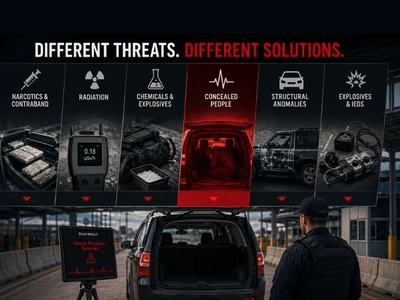
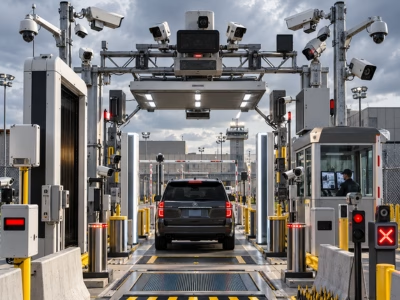
Vehicle inspection operations are changing to reflect the evolving complexity of threats. Not long ago, security screening was largely associated with permanent border crossings, correctional facilities, and fixed inspection lanes. Today, security agencies...

Hidden Lives, Hidden Threats

Hidden Lives, Hidden Threats

The Role of Heartbeat Detection in Combating Human Trafficking Human trafficking is one of the world's most pervasive forms of organized crime. Every year, criminal networks exploit millions of people through forced labor, sexual exploitation, and other forms of...

Choosing a Heartbeat Detection System

Choosing a Heartbeat Detection System

Five Questions Every Agency Should Ask Every correctional facility has security procedures designed to reduce risk. Cameras monitor activity, officers inspect vehicles, and access controls help regulate who enters and leaves the facility. Yet one challenge remains...