
Geospace Technologies Corporation (NASDAQ: GEOS) (“the “Company”) today announces a Permanent Reservoir Monitoring contract award for Mero Fields 3 and 4 from Petrobras, operator of the Mero field Consortium. The contract encompasses the supply and installation of nearly 500km of the OptoSeis® Permanent Reservoir Monitoring (PRM) system covering 140 sq km of seabed area of Mero, located deep offshore in the Santos Basin, 180 kilometers off the coast of Rio de Janeiro, Brazil.
This multi-year contract, which begins in June 2025, includes the engineering, procurement, construction, and operation of the OptoSeis® PRM system. The contract also includes installation, which is to be completed by Blue Marine Telecom, a Brazilian subsea cable company. The OptoSeis® system will be used to monitor and optimize oil production from the Mero field. The PRM system is based on the OptoSeis® technology developed by PGS and acquired by Geospace in 2018. OptoSeis® technology was previously deployed as the world’s first deepwater PRM system on the Jubarte field more than a decade ago, providing excellent 4D results, a more accurate reservoir model and improved drilling decisions.
OptoSeis® multicomponent sensors recover more seismic energy by leveraging their high dynamic range, wide bandwidth, superior fidelity, low crosstalk, and pressure balanced design. With a system noise floor well below offshore environments, the OptoSeis® system provides superior data quality as compared to other technologies.
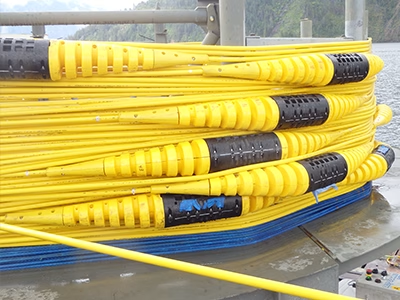
OptoSeis® Fiber Optic Permanent Reservoir Monitoring
The operations of the unitized Mero field are conducted by the Consortium operated by Petrobras, in partnership with Shell Brasil, TotalEnergies, CNODC, CNOOC and Pré-Sal Petróleo S.A (PPSA), as the Brazilian Government’s representative in the non-contracted area.
“We are delighted to be selected by Petrobras and their partners as the technology of choice to deploy over 490 km of our OptoSeis® PRM system in deep waters off the coast of Brazil. We look forward to our collaboration over the coming years on this most important and valuable project to maximize and improve the efficiency of reservoir management,” said Rich Kelley, CEO and President of Geospace. “I offer tremendous congratulations to the technical teams involved in this thorough process from the earliest conversations, through the tender response all the way to contract negotiations and closure. I also want to thank all of our partners that supported us during this process. We look forward to delivering a reliable, robust and permanent solution of value to Petrobras.”