Why Now Is the Moment to Rethink Vehicle Screening
Correctional security has always evolved in response to risk. From perimeter fencing to electronic access control to digital surveillance, each advancement has been driven by the same question: How do we better protect officers, inmates, and the public with the resources we have?
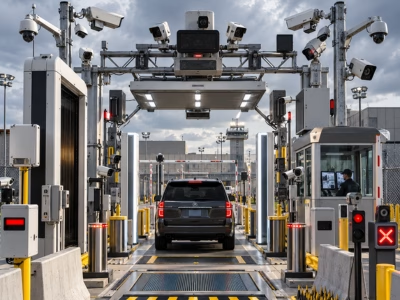
Today, correctional facilities across the United States are facing a convergence of pressures—staffing shortages, aging infrastructure, budget constraints, and increasingly sophisticated security threats. At the center of this challenge is one of the most overlooked control points in the facility: vehicle screening.
The moment to modernize how vehicles are screened is no longer approaching—it has arrived.
A Changing Risk Environment
Vehicle traffic into correctional facilities has not decreased. If anything, it has become more complex. Facilities must accommodate deliveries, contractors, service providers, and interagency operations—often through the same access points used decades ago.
At the same time, correctional leaders are being asked to do more with fewer personnel. Manual inspection processes that rely heavily on unloading cargo, visual checks, and officer intuition are increasingly difficult to sustain. These methods were never designed for today’s staffing realities or operational tempo.
Intelligence, Not Complexity, Is the Next Step
Modern correctional security is not about adding layers—it is about adding clarity.
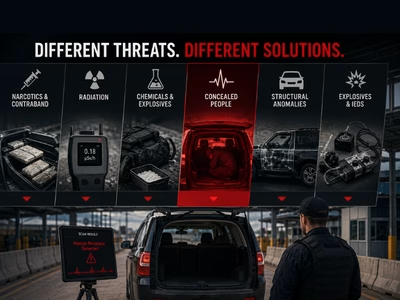
Human-detection technology changes the vehicle screening equation by answering the most critical question first: Is a person concealed inside this vehicle? When that question is answered quickly and consistently, every downstream decision becomes safer and more efficient.
Instead of relying on exhaustive searches for every vehicle, facilities can focus on areas where risk has been confirmed. This shift from assumption-based screening to intelligence-driven screening represents a fundamental modernization of checkpoint security.
Accountability as a Security Multiplier
As correctional systems face greater scrutiny, the ability to demonstrate consistent procedures and accountable decision-making has become essential. Digital records documenting who conducted screenings, when they occurred, and the outcome are no longer a “nice to have.” They are a requirement.
Vehicle screening technologies that embed accountability into daily operations strengthen not only security but confidence among leadership, oversight bodies, and the public.
Why Modernization Is Happening Now
Several forces are aligning to make this the right moment to rethink vehicle screening:
- Staffing shortages have reached levels that demand efficiency, not added labor.
- Budgets increasingly favor predictable operating expenses over large capital purchases.
- Security threats continue to evolve, while the infrastructure in many facilities has not.
- Technology has matured to the point where human detection can be deployed quickly, safely, and at scale.
Together, these realities make maintaining the status quo more risky than adopting something new.
A Practical Path Forward
Modernization does not require tearing down existing systems or reinventing operations. It requires targeted improvements at the most critical points.
Vehicle screening is one of those points.
By introducing modern human-detection capability at the gate, correctional facilities can:
- Reduce reliance on manual, labor-intensive searches
- Improve officer safety at high-risk access points
- Maintain throughput without sacrificing security
- Establish consistent, auditable screening practices
This is not a future-state vision—it is a practical, deployable step available today.
Built for the Reality of Corrections
Under the Geospace Technologies brand, the Heartbeat Detector represents this new approach to correctional vehicle screening. It reflects a broader shift toward security technologies that are not only effective but also accessible, accountable, and aligned with operational reality.
Modernizing correctional security does not mean adopting every new technology. It means choosing the right ones—at the right control points—at the right time.
For vehicle screening, that time is now.
Sources: Prisoner Statistics, Correctional Workforce Development, Corrections Research, Correctional Technology Resources