Top Five Vehicle Inspection Hurdles
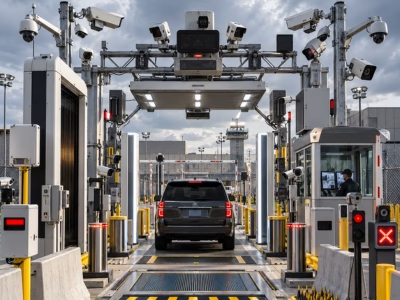
Vehicle inspections are one of the most important security procedures performed at correctional facilities. Every employee, contractor, vendor, visitor, and delivery vehicle passing through a secure perimeter represents an opportunity to prevent unauthorized people or prohibited items from entering or leaving the institution.
While inspection procedures are well established, carrying them out consistently is becoming more difficult. Staffing shortages, evolving threats, and increasing operational demands have changed the environment in which correctional officers work.
Understanding these challenges helps correctional leaders evaluate where improvements in procedures, training, and technology can strengthen overall security.
1. Maintaining Consistency During Busy Operations
Correctional facilities rarely experience steady traffic throughout the day.
Vehicle activity often peaks during shift changes, scheduled deliveries, maintenance work, medical services, or construction projects. During these periods, officers must balance security with operational efficiency while avoiding unnecessary delays.
The National Institute of Justice (NIJ) has identified staffing shortages as one of the highest-priority challenges facing correctional agencies, making consistent security procedures increasingly difficult to maintain during high-demand periods. When fewer personnel are responsible for more operational tasks, maintaining inspection consistency becomes even more important.
Source: National Institute of Justice, Experts Identify Priority Needs for Addressing Correctional Agency Security Threats
2. Inspecting a Wide Variety of Vehicles
Few correctional facilities inspect only one type of vehicle.
On any given day, officers may encounter:
- Employee vehicles
- Food service deliveries
- Medical suppliers
- Utility contractors
- Waste removal trucks
- Construction equipment
- Law enforcement vehicles
Each presents different inspection considerations, cargo configurations, and operational requirements. Inspection procedures must remain effective without unnecessarily disrupting facility operations.
3. Balancing Security with Throughput
Every correctional agency wants thorough inspections.
At the same time, facilities must keep operations moving.
Delivery schedules, emergency maintenance, transportation services, and shift changes all depend on efficient vehicle movement. Long inspection delays can affect daily operations, while rushed inspections may increase security risk.
The challenge is finding inspection procedures that improve security without creating operational bottlenecks.
4. Responding to Evolving Threats
Correctional security challenges continue to evolve.
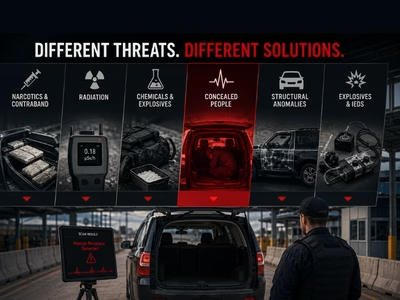
Research sponsored by the NIJ has documented increasing concerns surrounding contraband cell phones, synthetic drugs, drones, weapons, and organized criminal activity. Rather than relying on a single security measure, researchers conclude that effective facilities employ multiple complementary layers of protection.
Vehicle inspections play an important role within that broader security strategy by helping identify threats before they enter secure areas.
Source: National Institute of Justice, Contraband and Interdiction Strategies in Correctional Facilities
5. Doing More with Limited Resources
Perhaps the greatest challenge facing correctional administrators today is maximizing available personnel.
Correctional officers perform a wide range of responsibilities beyond vehicle inspections, including perimeter security, inmate movement, emergency response, visitor processing, and facility operations.
As staffing pressures continue, agencies increasingly evaluate technologies that improve operational efficiency while allowing officers to maintain consistent security procedures.
Technology should never replace experienced correctional professionals. Instead, it should help them perform their duties more effectively by providing additional information, improving consistency, and supporting informed decision-making. Trusted technology makes a significant difference is managing those resources. When the operators have confidence in the results a technology tool delivers, evidence suggests they are more likely to leverage the tool and improve workflow. An example of this type of technology is the Heartbeat Detector, which has been independently tested to a 99% accuracy rating.
Looking Ahead
Vehicle inspections have always been an essential component of correctional security. Today’s operational environment makes them even more important.
Staffing shortages, changing threats, and growing operational demands require agencies to continuously evaluate how inspections are performed and where improvements can be made. By combining well-defined procedures, ongoing training, and appropriate technologies, correctional facilities can strengthen one of the most important layers in their overall security strategy.
Learn More
National Institute of Justice
- Experts Identify Priority Needs for Addressing Correctional Agency Security Threats
- Contraband and Interdiction Strategies in Correctional Facilities
- Contraband and Interdiction Modalities Used in Correctional Facilities