Great Products Start Long Before Production Begins
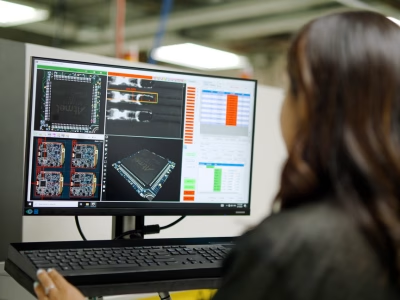
When an electronic product reaches the manufacturing floor, many of its most important decisions have already been made. Component placement, board layout, material selection, testing requirements, and assembly methods are all determined during the design phase. While these choices may seem purely engineering-related, they directly impact manufacturing efficiency, product quality, production timelines, and long-term reliability.
This is the principle behind Design for Manufacturability (DFM).
DFM is the practice of designing products with manufacturing in mind from the very beginning. Rather than waiting until a design is complete, engineering and manufacturing teams collaborate early to ensure a product can be built efficiently, consistently, and at scale.
For OEMs developing complex electronic products, DFM has become one of the most valuable ways to reduce risk before production even begins.
What Is Design for Manufacturability?
Design for Manufacturability is an engineering approach that evaluates how product design decisions affect the manufacturing process.
Instead of asking, “Can we build this?”
DFM asks a more important question:
“Can we build this reliably, efficiently, and repeatedly?”
A successful DFM review considers every aspect of production, including:
- PCB layout
- Component selection
- Assembly methods
- Testability
- Material availability
- Manufacturing tolerances
- Product reliability
- Production scalability
The objective is not to change the product’s intended function—it is to improve how that product is manufactured.
Why DFM Matters More Than Ever
Electronic products continue to become smaller, more powerful, and more complex.
Modern PCB assemblies often incorporate:
- High-density component placement
- Surface mount technology (SMT)
- Fine-pitch components
- Mixed analog and digital circuitry
- Wireless communications
- Embedded processors
- Specialized connectors
As complexity increases, so does the importance of manufacturing planning. Small design decisions that seem insignificant during development can create major challenges once production begins. A DFM review helps identify these issues before they become costly production problems.
Common Manufacturing Challenges DFM Helps Prevent
Many manufacturing delays are not caused by equipment—they are caused by design decisions.
Some common examples include:
Difficult Component Placement
Components placed too closely together can make automated assembly more difficult and increase inspection complexity.
Limited Test Access
Without adequate test points, validating PCB performance becomes more challenging and can increase troubleshooting time.
Component Availability
Selecting components with long lead times or limited availability can delay production and complicate future procurement.
Excessive Manufacturing Complexity
Designs that require unnecessary assembly steps increase production time while creating more opportunities for variation.
Thermal Considerations
Component placement can affect heat dissipation, influencing both assembly quality and long-term product reliability.
Addressing these challenges during design is significantly easier than correcting them after production begins.
Better Manufacturing Begins with Better Collaboration
Historically, engineering and manufacturing teams often worked sequentially.
Engineering completed the design. Manufacturing built the product.
Today, that model is changing.
Leading OEMs increasingly involve manufacturing partners during product development, allowing manufacturing expertise to influence design decisions before they become production constraints.
This collaborative approach enables teams to:
- Identify manufacturability improvements
- Simplify assembly processes
- Improve production consistency
- Reduce engineering revisions
- Accelerate product launches
The result is a smoother transition from design to manufacturing.
DFM Improves More Than Manufacturing Costs
Although DFM is often associated with cost reduction, its benefits extend much further.
Well-executed DFM can improve:
- Product Quality: Designs optimized for manufacturing are generally easier to assemble consistently, reducing variation between production runs.
- Faster Production: Simplified manufacturing processes reduce assembly time and improve production throughput.
- Greater Reliability: Products designed with manufacturing in mind often experience fewer assembly-related defects and improved long-term performance.
- Easier Scaling: Products that perform well during prototype builds are far easier to transition into higher production volumes when manufacturing has been considered from the start.
- Improved Supply Chain Flexibility: Alternative components and manufacturing options can often be identified during DFM reviews, reducing future sourcing challenges.
DFM Supports the Entire Product Lifecycle
Design decisions made today affect products for years.
A successful DFM review helps prepare products for:
- Prototype development
- Pilot production
- Full-scale manufacturing
- Product revisions
- Future design updates
- Long-term production support
Rather than solving today’s manufacturing challenges, DFM helps prevent tomorrow’s.
Choosing a Manufacturing Partner That Adds Engineering Value
Not every contract manufacturer participates in the engineering process. Some simply manufacture to print. Others become active collaborators throughout product development. For OEMs developing complex electronic products, the latter approach often delivers greater long-term value.
Manufacturing partners with engineering expertise can provide practical feedback on manufacturability, assembly methods, testing strategies, and production scalability before designs are finalized.
That collaboration helps reduce production risk while improving overall project outcomes.
Engineering and Manufacturing Work Best Together
At Geospace, engineering and manufacturing are closely connected throughout the product development process. Our teams work alongside customers to evaluate manufacturability early, helping identify opportunities to simplify production, improve quality, and prepare products for scalable manufacturing.
Combined with vertically integrated capabilities—including PCB assembly, precision machining, injection molding, cable and wire harness assembly, system integration, and quality assurance—this collaborative approach helps customers move confidently from concept to production.