Water Management Is Entering a New Era
Commercial real estate has become significantly smarter over the past decade.
Building automation systems optimize HVAC performance. Access control systems improve security. Smart lighting reduces energy consumption. Property management platforms provide greater visibility into operations than ever before.
Water management, however, has often remained one of the last major building systems managed reactively.
When a leak occurs, maintenance responds. When a pipe bursts, repairs begin. When water damage is discovered, restoration follows.
While this approach has been standard practice for decades, today’s operating environment is forcing property owners to think differently.
Rising insurance costs, aging infrastructure, staffing shortages, and growing expectations for operational efficiency are changing how commercial real estate organizations evaluate risk. Rather than asking how quickly maintenance can respond after a problem occurs, many are beginning to ask a more strategic question:
How can we reduce the likelihood and impact of water-related incidents altogether?
That shift is transforming water damage from a maintenance concern into a business priority.
The Cost of Water Damage Extends Beyond Repairs
When people think about water damage, they often picture wet flooring, damaged drywall, or plumbing repairs.
Those costs are real—but they’re rarely the only consequence.
A significant water event can create operational challenges that extend well beyond the maintenance department.
Property owners may also experience:
- Business interruption
- Resident or tenant disruption
- Lost rental revenue from uninhabitable spaces
- Insurance claims and deductibles
- Increased maintenance workloads
- Damage to equipment and building systems
- Delayed capital improvement projects as resources shift to emergency repairs
For organizations responsible for multiple buildings or large multifamily communities, even a single incident can consume valuable time and resources.
The true impact of water damage is measured not only by what must be repaired, but by everything that is disrupted along the way.
Reactive Maintenance Has Its Limits
Traditional water management follows a familiar pattern.
- A leak occurs.
- Someone discovers it.
- Maintenance is dispatched.
- Water is shut off.
- Repairs begin.
The challenge isn’t necessarily the response itself—it’s the amount of time that passes before anyone knows a problem exists.
Consider a leak that begins in a vacant apartment over a holiday weekend. By the time staff return, what may have started as a small plumbing failure could now involve drywall replacement, flooring restoration, and additional remediation.
As maintenance teams continue managing larger portfolios with limited personnel, relying solely on routine inspections and resident reports becomes increasingly difficult.
This is one of the reasons commercial real estate is beginning to embrace a more proactive approach to water management.
From Reactive Maintenance to Commercial Water Risk Management
Leading property owners are starting to think about water the same way they think about other critical building systems—as something that should be monitored, managed, and supported with data.
Rather than reacting to water events after they occur, they are investing in technologies that improve visibility across their properties.
Modern smart water management systems can help property teams:
- Monitor water activity across one or multiple properties
- Receive alerts when abnormal water usage or potential leaks are detected
- Identify issues earlier before they become costly repairs
- Remotely control water service when immediate action is required
- Improve visibility into property-wide water operations
This approach—Commercial Water Risk Management—isn’t about eliminating every leak.
It’s about reducing the operational and financial impact when water-related events occur.
Smart Water Technology Supports a More Resilient Operation
The evolution of smart buildings has shown that better information leads to better decisions.
Water management is following the same path.
Connected technologies now enable property owners to move beyond simply reacting to problems and toward actively managing one of their most important building systems.
Depending on operational objectives, a modern smart water strategy may include:
- Connected leak detection that provides early visibility into abnormal water activity
- Remote water control that allows authorized personnel to shut water off without sending maintenance into the field
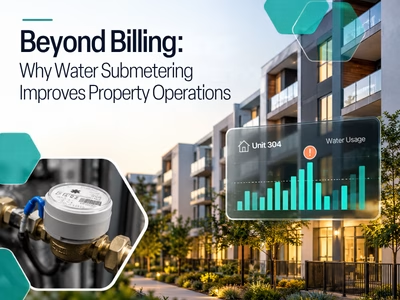
- Water submetering that improves visibility into individual unit consumption while supporting more accurate utility cost recovery
- Cloud-based dashboards that provide centralized monitoring across multiple properties
- Analytics that help identify recurring issues and long-term consumption trends
Together, these capabilities help maintenance teams spend less time responding to emergencies and more time focusing on preventative operations.
Building a Connected Water Strategy with Geospace
Modern water management isn’t defined by a single device.
It is the combination of connected technologies working together to improve visibility, accelerate response, and simplify property operations.
Geospace’s Aquana® Commercial Real Estate solutions were developed around this philosophy.
Rather than requiring organizations to choose between leak detection, remote water control, or water submetering, the Aquana platform allows property owners to implement the capabilities that best support their operational goals.
Depending on the application, organizations can deploy:
- Asset Protection – leak detection, real-time alerts, and remote water control to help identify and respond to water-related issues before they escalate.
- Water Submetering – unit level consumption visibility that supports accurate billing, cost recovery, conservation, and better water management.
- Centralized Water Management – cloud-based monitoring and control that gives property teams visibility across units, buildings, or entire portfolios.
Whether protecting a multifamily community, commercial office, student housing development, or mixed-use property, connected water technologies help organizations move beyond reactive maintenance toward proactive operational management.
Looking Ahead
Commercial real estate is becoming more connected, more automated, and more data-driven. Water management is evolving alongside it. Organizations that continue relying exclusively on reactive maintenance may find themselves facing increasing operational costs, greater insurance exposure, and unnecessary disruption from events that could have been identified earlier.
The opportunity isn’t simply to respond faster. It’s to build a smarter, more resilient approach to managing water across an entire property portfolio.
Because today, water damage isn’t just a maintenance issue. It’s a business risk.