Why Vehicle Screening Deserves a Modern Approach
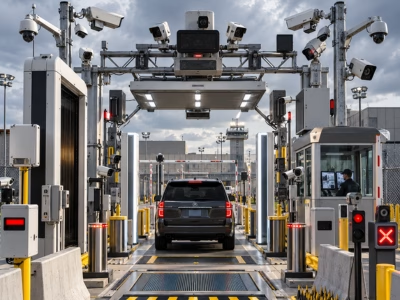
Correctional facilities are designed around layers of protection—perimeter fencing, controlled access points, surveillance systems, and trained personnel. Yet one of the most critical security vulnerabilities often arrives on wheels. Delivery trucks, maintenance vehicles, service vans, and contractor traffic are essential to daily prison operations. At the same time, these vehicles represent one of the most common—and most dangerous—paths for contraband smuggling, unauthorized access, and escape attempts. For correctional leaders tasked with maintaining safety, vehicle screening is no longer optional—it is foundational to modern prison security.
The Hidden Risk at the Gate
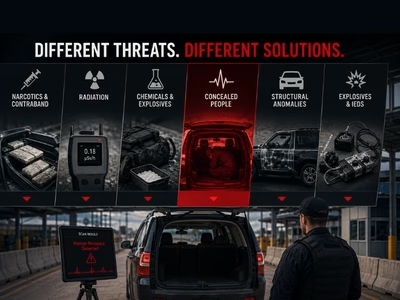
Traditional vehicle screening methods rely heavily on visual inspections, mirrors, manual searches, or partial unloading of cargo. While these methods may detect surface-level threats, they struggle to address a more dangerous risk: hidden human presence.
Individuals concealed inside vehicles—whether intentionally or under duress—can bypass even well-established perimeter controls. These incidents place correctional officers at risk, disrupt facility operations, and expose agencies to severe safety and liability concerns.
An often overlooked vehicle screening risk in correctional facilities stems from inmate labor programs that support outside industries. Every day, facilities load finished goods (manufactured, packaged, or assembled by inmates) onto outbound trucks for distribution. These shipments are legitimate, routine, and often time-sensitive. At the same time, they create a high-risk opportunity for inmates to conceal themselves within cargo, pallets, or compartments and attempt escape under the cover of normal operations. Without a reliable way to detect human presence inside these outbound vehicles, facilities are left with a critical blind spot at the gate.
As correctional systems face staffing shortages, increasing inmate populations, and evolving security threats, relying solely on manual inspection processes creates an unsustainable burden on personnel.
Why Vehicle Screening Deserves a Modern Approach
Modern correctional security demands solutions that are:
- Fast, to prevent operational bottlenecks
- Reliable, regardless of vehicle type or cargo
- Non-intrusive, so inspections don’t disrupt daily workflows
- Consistent, removing guesswork and variability between officers
Vehicle screening is no longer just about stopping contraband—it’s about protecting officers, safeguarding inmates, and maintaining the integrity of the entire facility.
Human Detection: A Critical Missing Layer
While cameras, access controls, and perimeter sensors have advanced significantly, many facilities still lack a reliable method for detecting human presence inside vehicles before they enter secure zones.
Human detection technology addresses this blind spot by focusing on what matters most: identifying concealed individuals without requiring invasive searches or time-consuming unloads. This capability is especially critical at entry/exit points and truck gates, where vehicles often transition directly from unsecured to secured areas.
Raising the Standard for Correctional Security
Forward-looking correctional agencies across the U.S. are reevaluating how vehicle screening fits into their broader security strategy. The goal is no longer to add complexity, but to add intelligence—technology that enhances officer effectiveness rather than slowing it down. By integrating human detection into the vehicle screening process, facilities gain:
- Faster, more consistent inspections
- Reduced reliance on manual searches
- Improved officer safety at high-risk access points
- Greater confidence in perimeter integrity
A Smarter Path Forward
At Geospace Technologies, security solutions are built around a simple principle: solve customer’s challenges with innovative solutions that provide sustainable long-term value. Drawing on decades of experience in advanced sensing technologies used worldwide in defense, border security, and critical infrastructure protection, Geospace is bringing proven human detection capabilities into the correctional environment.
Vehicle screening is no longer just a checkpoint—it is a strategic control point. And as correctional facilities modernize their security posture, addressing this blind spot is one of the most impactful steps they can take.
Sources: selected case studies and government/industry analyses on staffing shortages and gate vulnerabilities. (The Marshall Project, CorrectionalNews, OJP.gov, Corrections1)