

Mariner Deep
Extended Duration Ocean Bottom Node

PRODUCT DETAILS
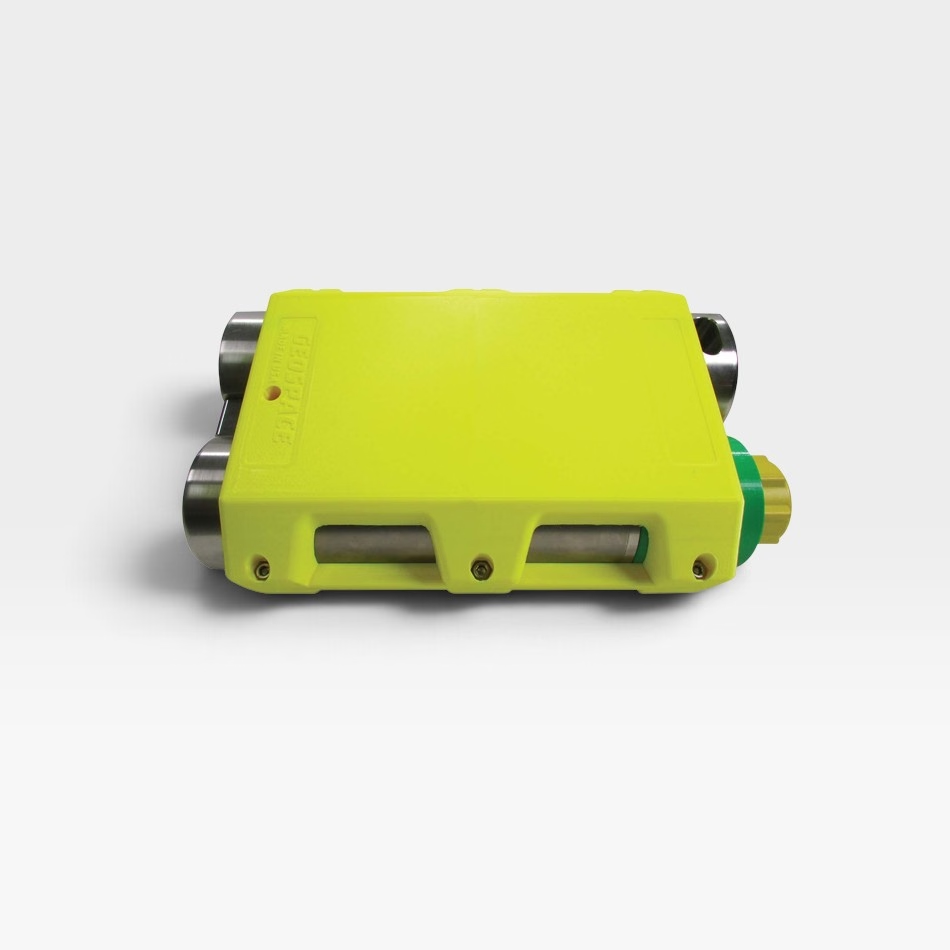
Featuring 10Hz geophones, Mariner Deep is designed for extended-duration seabed ocean bottom seismic data acquisition. Nodes can be deployed in depths up to 3,048 meters (10,000ft) with continuous recording for up to 200 days.
Featuring low frequency geophones, Mariner Deep is the next generation deepwater ocean bottom node designed for extended-duration ocean bottom seismic data acquisition. Each ocean bottom node features an internal heading sensor and uses all Geospace designed and manufactured sensor components including Deepender 5000-X hydrophone and three-component geophones. The built-in full resolution test generator offers users the added security of a fully functional recorder capable of low-frequency, high-fidelity data acquisition. The Mariner Deep has a flat pad, which an ROV can use to lift the device and place it in position.
Features
- Continuous, cable-free 4C autonomous recording
- Low frequency 10 Hz geophones
- Battery module: 200 days operation
- Built-in, full-resolution test generator
- Solid-state flash memory: 32 GB per channel
- Internal Heading Sensor
- 3 Component Magnetic Sensor
- ±5° Accuracy
- Measurements written to header every 2,000 samples
See What Others Can’t
Acquire seismic information from challenging deepwater environments.
Mariner Deep combines three-component geophone measurements with hydrophone recording to capture four-component seismic data at ocean depths exceeding 3,048 meters. Its 10 Hz geophones and high-resolution recording capabilities support the acquisition of subsurface information needed to evaluate complex offshore geology.
Turn Insight into Action
Support confident decisions with extended-duration seismic data.
Mariner Deep’s autonomous recording, internal heading measurements and built-in test generator help acquisition teams collect and assess seismic information during offshore surveys. These capabilities support data quality assessment and provide geophysical teams with the recordings needed for subsurface processing and interpretation.
Do More with Less
Extend recording time and reduce operational costs.
With up to 200 days of continuous recording, Mariner Deep supports long-duration seismic acquisition without frequent battery replacement or node servicing. Cable-free operation and extended battery capacity give offshore contractors greater flexibility when planning deployments, helping reduce operational interruptions in environments where vessel time and logistics are costly.
Frequently Asked Questions About Mariner Deep
Deepwater seismic acquisition places demanding requirements on recording equipment, particularly when projects involve extended deployments and complex offshore logistics. Mariner Deep combines long-duration autonomous recording, four-component seismic measurement, and a pressure-rated housing to support these operations. Its design emphasizes reliable data acquisition and the flexibility to plan surveys around operational requirements rather than frequent equipment servicing.
What should contractors consider when selecting an ocean-bottom node for deep water surveys?
Deepwater OBN selection requires careful consideration of operating depth, recording duration, sensor performance, onboard storage, and deployment logistics. Mariner Deep is designed for extended-duration acquisition, with a maximum rated operating depth of 3,048 meters and continuous recording capability of up to 200 days. Its four-component recording system, internal heading sensor, and high-resolution digitization support the technical requirements of deepwater seismic surveys.
How deep can Mariner Deep operate?
Mariner Deep has a published maximum operating depth of 3,048 meters (10,000 feet), with a housing pressure rating of 30.4 MPa (304 bar). The system is engineered for deepwater seabed seismic acquisition where equipment must operate under substantial hydrostatic pressure. Its pressure-rated construction supports autonomous recording throughout the deployment period, within the specified operating limits.
How long can Mariner Deep continuously record?
Mariner Deep supports up to 200 days of continuous autonomous seismic recording. Its long-duration battery module enables extended seabed deployments without requiring an external power connection. The system also provides 32 GB of solid-state flash memory per recording channel. These capabilities give acquisition contractors greater flexibility when planning survey schedules and long-duration offshore operations.
Why is extended duration recording important for deepwater OBN surveys?
Deepwater node deployment and recovery can involve significant vessel resources, specialized equipment, and complex logistics. Extended recording capability gives contractors more flexibility to accommodate acquisition schedules without retrieving nodes solely to replenish battery power. With up to 200 days of continuous operation, Mariner Deep is designed to support long-duration projects while helping reduce operational interruptions associated with equipment servicing.
What seismic sensors are used in the Mariner Deep?
Mariner Deep uses three orthogonally oriented Geospace GS-ONE OMNI 10 Hz geophones and one hydrophone for four-component seismic recording. The geophones measure particle motion along three axes, while the hydrophone records pressure variations. Together, these sensors provide multicomponent seismic data for subsurface imaging and analysis. The system’s 10 Hz geophones are designed to operate across varying orientations, supporting recording performance in seabed deployments.
How does Mariner Deep support seismic data quality during extended deployments?
Mariner Deep combines 24-bit digitization, selectable sample intervals, high-sensitivity seismic sensors, and onboard solid-state recording. Its specified instantaneous dynamic range is 129 dB at a 2 ms sample interval, with equivalent input noise of 0.12 µVrms under the same sampling condition. The system includes a built-in full-resolution test generator to support equipment verification. These capabilities help maintain consistent recording performance throughout extended acquisition operations.
How does Mariner Deep determine node orientation on the ocean floor?
Mariner Deep includes an internal three-component magnetic heading sensor with specified accuracy of ±5°. Heading measurements are written to the recording header every 2,000 samples, providing orientation information for subsequent seismic data processing. Accurate heading information is important when interpreting three-component particle-motion measurements and aligning the recorded data with the survey coordinate system.
How can Mariner Deep improve the economics of deepwater seismic acquisition?
Deepwater survey economics are influenced by vessel time, deployment and recovery operations, equipment utilization, and the cost of maintaining recording systems offshore. Mariner Deep’s extended battery life and autonomous operation allow contractors to plan longer deployments without interruptions solely for battery replacement. Its four-component recording system and onboard data storage support acquisition throughout these extended periods. By reducing certain servicing requirements and increasing operational flexibility, Mariner Deep can contribute to more efficient use of offshore resources.
GS-ONE OMNI 10 HZ Geophone
Physical Specifications
|
Moving Mass
|
13.2g
|
0.466 oz
|
|
Maximum coil excursion p-p
|
6.10 mm
|
0.240 in.
|
|
Minimum coil excursion p-p
|
0.89 mm
|
0.035 in.
|
|
Diameter
|
30.5 mm
|
1.2 in.
|
|
Height
|
43.2 mm
|
1.7 in.
|
|
Weight
|
125 g
|
4.40 oz
|
|
Operating and Storage Temperature Range
|
–40°C to +100°C
|
–40°F to +212°F
|
Electrical Specifications
All parameters are specified with 7.5 kΩ load at 25°C in all tilt positions unless otherwise stated.
|
Frequency
|
10 Hz
|
|
Spurious Frequency
|
150 Hz
|
|
Open Circuit Sensitivity
|
100V/m/s (2.55 V/i/s)
|
|
Resistance with Shunt
|
2500 Ω
|
|
Sensitivity at 70% Damping
|
85 V/m/s (2.15 V/in/s)
|
|
Total Damping
|
70%
|
|
Distortion at all tilt angles
|
<0.2% measured at 12 Hz with 0.1 in/s p-p
|
Hydrophone
Physical Specifications
|
Maximum Operating Pressure
|
30.4 MPa (4,400 psi)
|
|
Maximum Working Depth
|
3,048 m (10,000 ft.)
|
|
Operating Temperature Range
|
–10 to +75°C (+14 to 167°F)
|
Electrical Specifications
|
Nominal Capacitance(at 25°C 1atm)
|
10.0 nanofarads
|
|
Voltage Sensitivity
|
8.9 μV/μBar
|
|
Sensitivity (dBv ref 1μPa @ 25°C)
|
–201 dB re 1V/μPa
|
|
Frequency Response (into 2 MΩ load)
|
1 –30,000 Hz
|
Mechanical Specifications (Housing)
|
Metric
|
US
|
|
|
Length
|
358 mm
|
14.1 in.
|
|
Width
|
222 mm
|
8.8 in.
|
|
Height
|
118 mm
|
4.7 in.
|
|
Weight in Air
|
18 kg
|
39.6 lbs.
|
|
Weight in Seawater
|
12 kg
|
26.4 lbs.
|
|
Maximum Operating Pressure
|
30.4 MPa/304 Bar
|
4,400 psi
|
|
Maximum Operating Depth
|
3,048 M
|
10,000 ft.
|
|
Operating Temperature Range
|
–5°C to +60°C
|
+23°F to +140°F
|
|
Storage Temperature Range
|
–10°C to +60°C
|
+14°F to +140°F
|
ELECTRICAL SPECIFICATIONS
Digitized 4C Recording Station: 4 Channel, 32 Bit A/D Digitizer 3C Orthogonal oriented GS-One OMNI 10Hz -Geophones 1 Hydrophone
|
Digitization
|
32-bit Delta-Sigma
|
|
Sample Interval
|
0.5, 1, 2, 4 ms
|
|
Pre-amplifier Gains
|
0, 6, 12, 18, 24, 30, 36 dB
|
|
Maximum Input Signal
|
1.8 Vrms
|
|
Equivalent Input noise (@2ms sample interval)
|
0.12 μVrms
|
|
Gain Accuracy
|
Better than 1%
|
|
Anti-alias Filter
|
83% Nyquist
|
|
Instantaneous Dynamic Range
|
129dB @ 2 ms sample interval
|
|
THD
|
<0.2%
|
|
Distance Between Digitizer & Farthest Sensor
|
<18 cm
|
|
Distance Between All Sensors
|
<11 cm
|
|
Flash Memory
|
32 GB per channel
|
|
Frequency Response
|
1 Hz – 825 Hz @ 1/2 ms sample interval
|
|
Battery Module
|
200 days operation
|
Resources

