How the Heartbeat Detector® Improves Safety, Throughput, and Accountability
In correctional environments, security technology is only as valuable as its impact on daily operations. Solutions must enhance safety without slowing workflow, add control without increasing staff burden, and improve accountability without adding administrative complexity.
The Heartbeat Detector was designed with these realities in mind. Beyond its ability to detect concealed human presence, it delivers measurable operational benefits that help correctional facilities operate more safely, efficiently, and consistently—day after day.
The Staffing Reality Facing U.S. Corrections
Across the United States, correctional systems are operating under historic staffing pressure:
- National corrections surveys have reported vacancy rates of 20–40% for correctional officer positions in many state and county systems.
- Some jurisdictions have been forced to close housing units, limit programming, or mandate overtime due to insufficient staffing.
- Officers are increasingly asked to cover multiple roles per shift, raising fatigue levels and compounding safety risks—especially at high-exposure areas like vehicle checkpoints.
In this environment, every operational inefficiency carries real consequences. Vehicle screening processes that rely heavily on manual labor, unloading, and subjective decision-making consume the time correctional teams no longer have.
Improving Officer Safety at the Most Vulnerable Point
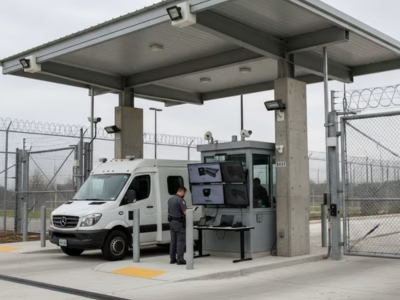
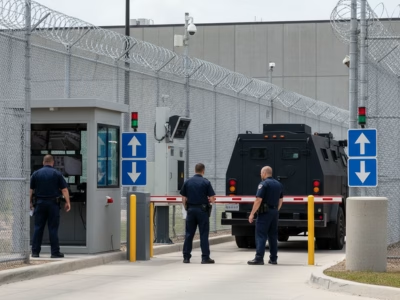
Vehicle checkpoints—particularly entry points and truck gates—are among the highest-risk areas in a correctional facility. Officers must make rapid decisions while exposed to unknown threats inside vehicles they cannot fully see.
By confirming whether a person is concealed before a vehicle enters a secure zone, the Heartbeat Detector:
- Reduces the likelihood of surprise encounters
- Minimizes close-contact manual searches
- Allows officers to escalate inspections only when necessary
In an era of staffing shortages, this added certainty reduces unnecessary exposure and helps protect limited personnel resources.
Increasing Throughput Without Compromising Security
Traditional vehicle screening methods often force a tradeoff between security and speed. Manual searches and cargo unloading can significantly slow operations, creating bottlenecks that ripple across already understaffed shifts. The Heartbeat Detector eliminates this tradeoff.
With screening results typically delivered in under one minute, facilities can:
- Maintain steady vehicle flow during peak delivery times
- Reduce congestion at sally ports and truck gates
- Avoid delays that pull officers away from other critical duties
This efficiency becomes especially valuable when fewer officers are available to manage the same or higher volume of traffic.
Standardizing Screening Across Shifts and Facilities
High turnover and accelerated onboarding have become realities in corrections. Manual inspection processes can vary widely depending on experience level, increasing inconsistency and risk.
The Heartbeat Detector introduces a standardized, repeatable screening process with:
- Clear procedures
- Automated analysis rather than subjective interpretation
- Consistent outcomes across operators, shifts, and facilities
This standardization supports continuity even as staffing fluctuates.
Strengthening Accountability and Compliance
In environments under staffing stress, accountability becomes even more critical.
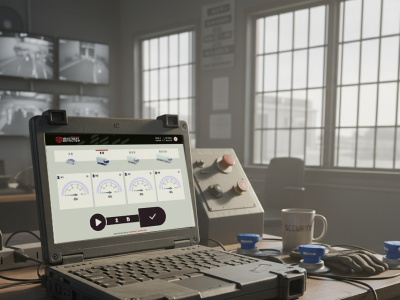
The Heartbeat Detector’s software automatically records: who conducted each screening, when it occurred, and the resulting outcome. These digital records provide a clear audit trail that supports compliance, internal reviews, and post-incident analysis — without adding administrative work for already overextended staff.
Lowering the Barrier to Adoption
Operational impact also depends on how easily a solution can be deployed.
Under the Geospace Technologies brand, the Heartbeat Detector is available through a cost-efficient leasing model, helping agencies adopt advanced vehicle screening without large upfront capital investments—an important consideration as budgets tighten and staffing shortages persist.
Designed for Today’s Correctional Reality
The Heartbeat Detector is built for the realities correctional facilities face today—not ideal conditions. By integrating seamlessly into existing workflows, it helps facilities do more with less while strengthening security where it matters most.
In an environment defined by staffing shortages and elevated risk, operational impact isn’t optional—it’s essential.
Sources: selected case studies and government/industry analyses on staffing shortages and gate vulnerabilities. (Sunset Advisory Commission, DOJ Office of Inspector General, Urban Institute)