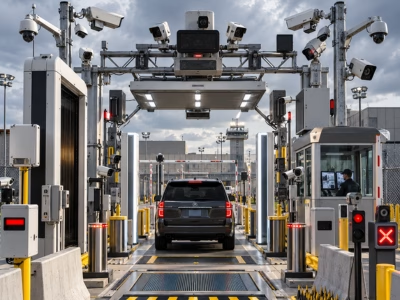
Border security has always required balance. Agencies are responsible for protecting national sovereignty, preventing illegal entry, and disrupting human trafficking, while still enabling the lawful movement of people and goods that economies rely on. That balance becomes most visible at vehicle checkpoints.
Every day, border operations process passenger vehicles, commercial trucks, and cargo moving through ports of entry, secondary inspection, and remote checkpoints. The scale is significant, and so is the challenge. Officers must make quick decisions with limited visibility into what is inside each vehicle.
The challenge hidden in everyday operations
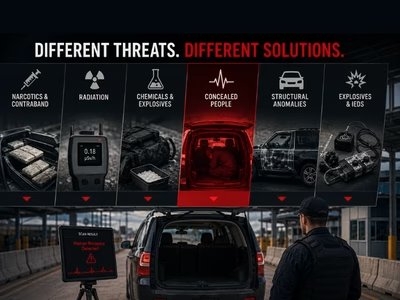
Many of the highest-risk scenarios are not obvious. They exist within normal traffic. Commercial shipments, passenger vehicles, and enclosed cargo spaces can all be used to conceal individuals attempting to cross undetected. Any enclosed space creates an opportunity for concealment.
At the same time, operations must maintain throughput and efficiency. According to the Bureau of Transportation Statistics, U.S. land ports of entry process millions of vehicle crossings each year. The scale alone requires inspection methods that are both fast and reliable.
Where traditional methods fall short
Current inspection tools each play an important role, but they also come with limitations.
Manual inspections take time and depend on access and visibility. They can vary from one operator to another and are difficult to scale across high traffic volumes. Canine units are effective but limited by availability and strict operational schedules designed to protect the animals. They cannot be deployed continuously. X-ray systems provide deep visibility into cargo, but they require significant infrastructure and investment. They can slow down operations and introduce safety considerations for both operators and occupants.
These methods are valuable, but none are designed to quickly answer a simple and critical question. Is there a person hidden inside this vehicle?
The Heartbeat Detector is designed to answer that question directly.
Instead of relying on visual inspection or imaging, it uses sensitive sensors to detect the subtle vibrations created by a human heartbeat. This allows officers to determine whether a person is present inside an enclosed space without opening the vehicle or disturbing the cargo.
The process is simple. The vehicle is stationary and the engine is turned off. Sensors are placed on the vehicle’s suspension. The system listens briefly and delivers a clear result. Operators receive a pass or search indication in seconds. This provides a consistent method of screening that does not depend on visibility or interpretation.
The technology has been deployed globally for decades and is used in more than a dozen countries to support border security and law enforcement operations.
Built for real-world border environments
Border operations vary widely, from high-volume ports of entry to remote checkpoints with limited infrastructure.
The latest version of the Heartbeat Detector has been redesigned with a significantly smaller footprint, reducing its overall size by 75%. This makes it easier to deploy across different environments without requiring permanent installation.
It can be used as a primary inspection tool to screen vehicles quickly, or as a secondary step to confirm findings alongside existing systems such as X-ray.
Improving outcomes in the field
Faster and more consistent detection improves decision-making at the checkpoint. Officers can focus their attention where it is needed most, reducing unnecessary manual inspections while maintaining throughput. Non-intrusive screening also enhances safety by limiting close-contact searches in uncertain situations.
This capability is especially important in efforts to combat human trafficking. According to U.S. Customs and Border Protection, human trafficking remains a serious global issue affecting millions of people. Effective detection at border crossings plays a critical role in identifying and protecting victims.
The Heartbeat Detector has been adopted by border and national police agencies across Europe, North Africa, and the Middle East. One of the most recent deployments includes La Guardia Civil, reflecting its continued role in modern border operations.
These real-world deployments demonstrate reliability across diverse conditions and operational demands.
As border operations continue to evolve, the need for fast, reliable, and non-intrusive detection will only increase. Vehicle screening remains one of the most important control points. Adding a focused human-detection capability gives officers a clearer understanding of what they are dealing with before taking action.